Showing posts with label chargen. Show all posts

Wednesday, 7 May 2025

Wiki Articles Are Wizards!

Wizards are bizarre uniquities who carve their own paths through reality like rogue stars.

Wiki Articles Are Wizards [citation needed] is my new zine for crafting these characters out of wiki articles, then pitting them against each other in a wizard-off!

To get a thematically consistent weird wizard with spooky powers and an appropriately unpleasant set of personality traits, you'll want to use procedural generation rather than strictly random generation. This small book gives you a comprehensive method for doing that, using wiki articles as the inspirational material, and has all sorts of bonus wizard-lore to boot.


🧙 Available today!


And I'm publishing a companion piece: a collection of troublesome characters, 30 Wicked Wizards!

From Miarthetrolut the Regulator (who meddles with fish kinematics) to Sthogar the Ambitious (and his reanimated giant spiders)!

The thirty wizards and archwizards in this zine-style book are all made using the Wiki Articles Are Wizards rules, all laid out in a splattery OSR style, and all very weird and wicked.


🧙 Also available today!


As well as print copies, you can get a digital edition of either zine!

Are you interested in both? Hey! You can grab the PDF bundle!


Wednesday, 16 April 2025

The retconned lifepath

I want to develop an idea about a novel RPG progression mechanic which was pitched here:

https://www.tumblr.com/alexanderwales/771838390587047936/pitchposting-retcon

The main idea is this: it's a narrative game where the majority of the gameplay involves placing the pieces of your own past.
[...]
So the whole game would be this: slowly adding to your own backstory, penning yourself in over time, until there's no room to maneuver anymore, and shortly thereafter, the game ends. The fundamental tension of the game is that you want to keep the character as amorphous as possible, to commit to as few details as possible, but commitment is necessary to actually accomplish things.
[...]
in this game "progression" does not come from increasing skills because you got better, it comes from defining the past.

I view this as an interesting twist on lifepaths.


Refresher: Lifepath mechanics

In TTRPG gaming, characters are classically generated by picking character elements (or clusters of them) from a set of options, supplemented with dice rolls to instantiate numerical attributes. Most games still do something in this vein.

A lifepath character generation system switches this up. Now you make early life decisions as your character, and/or roll to see what happened to them before gameplay began, and the outcome of that process is your character's start state.

(Aside: I made a comprehensive lifepath character generation book for D&D 5e which you can check out here: https://www.drivethrurpg.com/product/438774/Steps-to-a-Hero)


Lifepaths are an attractive alternative because they (can) restrict a player's decisions to only those of their character, not a bunch of things that their character was never in a position to choose themselves like their 'intelligence' stat. As a result,

  • They add more gameplay to the game
  • They feel more real
  • They reduce the pressure on the player to be creative
  • They replace the part of a role-playing game that has little to no role-playing (character generation) with a version that is mostly role-playing

Refresher: Retcon mechanics

Retcon is retroactive continuity. It's a broad category of ideas, and 'deciding parts of the past which were left undecided' is just one very narrow part.

The main RPG retcon mechanic I'm familiar with is the one Alexander Wales mentions in his pitch. Blades In The Dark, the GLOG, etc, permit a character by 'careful preparation' to retcon in things they have available to them, e.g., by carrying a bundle of unspecified equipment.

Outside of RPGs, something like this is a common part of story-telling games, where there are mechanisms for a player (as opposed to game master) to determine or replace parts of the world, often to the benefit of a character favoured or controlled by that player.


A possible synthesis

So we have this idea for, essentially, building a character by determining underdetermined bits of a lifepath.

➡️ Let's say characters all start at age 25, having had formative experiences since the age of 15, and initially have just one or two of their traits determined.

➡️ There's experience points, and you 'spend' xp at any time to declare how you 'spent' one year of your life (a nice little verbal correspondence).

➡️ Each year of your life grants you an appropriate character trait: an ability, skill, power, whatever.

➡️ Each trait you 'gain' in this way is, of course, one you've always had within the continuity of the game world. You're just revealing it now.

So you decide you spent a year traipsing the desert trade routes, and get increased endurance. Or you were pressed into military service as an archer, and are capable with a war bow. Or you spent a year repairing fishing trawlers, and have basic sailing and carpentry skills.

This setup allows for ten "level-ups", one for each adult / young adult year of your life prior to starting the game proper. You could tweak the time periods to get more buffer. If you do bump into the end game having 'spent' all your undetermined years, the game master would need to contrive a year-long time skip between adventures for the player characters to keep progressing, or switch to a different progression system.

Other than managing time, I see two main open problems. They're shared by most retcon / story-influencing mechanics:

  1. Things in the game world can / should be able to interact with your character's history before you're "ready" to determine it. When this happens, the choices are: do the character advancement early, contrive a way out of revealing (deciding) it, or suffer contradiction later on.
  2. When you do determine part of your character's history, it may make previous in-character choices and outcomes seem very stupid indeed. "You're telling me you apprenticed as an acrobat for a year? So have you been deliberately clumsy these last few weeks?"


Closing thoughts

By its nature, I think as a class of game mechanic this idea leans a bit towards the story-telling game end of the spectrum. It doesn't have many of the advantages of lifepaths which I mentioned.

It's a way for players to influence the overall narrative or game world more than their character's decisions. So I think if you were to develop it further, you'd be better off implementing it in a story-telling game or hybrid game rather than a 'strict' TTRPG.

Thursday, 8 February 2024

Character class: Gestalt of magic items

Game idea status: Non-instantiated; untested

The pitch

In your next tabletop role-playing game, you play as a mismatched assortment of sapient magic items. You are seeking like-minded paraphernalia to add to your burgeoning hivemind. Underneath the magical finery and glowing gemstones is a small, timid commoner who doesn't really know what is going on, but who you have formed a fierce attachment to.


Being a magical treasure hoard

Character idea: You are four or five magic items, of various levels of intelligence and various capabilities. Parts of you can move. Others can perceive their environment. Others can communicate with the fleshy types, or puppet their movements. You work in superb co-ordination, each making the others stronger, and forming a gestalt entity stronger than the individual nodes in your network.

Possible appearance: An old biddy is napping in an ornate wooden throne which walks on four clawed feet, careful not to wake her. She grips a glowing sword as she snoozes – its blue blade dances this way and that, clearly moving her bony arm rather than the other way around. A griffon's head graven upon a shield glares from the top of the throne, held by an animated rope. In the old lady's lap is an hourglass absolutely dripping with fretwork skulls; within, the sand is frozen in time.

Motivation: You are lonely and incomplete. You seek missing members of once-paired items, objects of particular aesthetics to complete your look, magical swords of similar alignment, bored cursed amulets, and so on.

Terminology: You are a gestalt entity. Your prospective compatibility with other sapient magic items you might come across is your gestalt personality. The person you have convinced to carry all of your components around (the ones that can't carry themselves) is your host. They perform tasks for you and in return you shower them in good luck, ability bonuses, conjured food, saleable abilities, magical protections, and adventure.

Legal status: Chances are, the local magistrates' willingness to recognise you as a self-actualised individual is highly questionable. Even in the kind of utopia which does grant personhood to smart objects, you are likely still on the run from covetous dragons and other unsavoury types.

Niche protection: Are you kidding me?


Possible magic item: A carved jade guardian lion affixed to an ornate golden platform


Player characters and hosts

These objects have achieved concordance, or at least codependence, through a history of amicable cooperation. They fundamentally want to remain together; they have no interest in being separated.

Therefore, the character is never at risk of being "parcelled out" by other PCs.

Sapient artefacts are notoriously difficult for a living wielder or wearer to get on with nicely. You have problems of:

  • Personality or alignment conflict
  • Jealousy or disparagement of other magic items (and their different nature or perceived utility)
  • Jealousy of the capabilities of the living, or criticism of their perceived weaknesses
  • Pridefulness; expectation of obedience or submission from all other than the item's maker
  • Disrespect of the long-lived and unbreakable for organic intelligences
  • The desire to be carried at all times, to be treasured, to be maintained and given consideration above the bearer's more intrinsic goals
  • Items having instinctual control over their wielder or wearer in various ways, and unwilling or unable to suppress it for long

It's a rare person indeed – and a meek, biddable one – who meets all the slightly different criteria of a whole assemblage of such items.

Therefore, the character is not at risk of disappearing because it "makes sense" for some other PC to wield and wear them all at once.

At some point, the gestalt entity's host – a person who is probably regarded as something between a valued servant, a sapient home, and a fascinating pet – might die. This is not sufficient reason for another PC to stand in, except as an extremely short, uncomfortable stopgap until the gestalt entity can travel to a population centre to begin the long, arduous search for another truly suitable host. This may or may not be considered a form of character death, dependent on the nature of the particular game.


Possible magic items: Assortment of axes


Game mechanics

Take a character sheet and some scissors, and cut away everything but the important box which says 'equipment list'.

I'm not going to go so far as to instantiate this character class for any particular game system.

Obviously it's going to take some GM work. The following guidelines occur to me.

How to handle advancement:

  • Start out with four or five magic items, able to communicate amongst themselves telepathically, visually, and/or tactilely. Between them they should have the ability to move around, communicate with other folks, protect themselves, perceive their environment, and do something that could be leveraged to make money to pay their way. They should also have a short list of utility or battle powers – say, one per item.
  • The player should be (e.g.) picking from a set of pre-prepared candidate objects/powers rather than getting to pick all the details of the magic items for their starting gestalt character.
  • For character progression, switch up between unlocking new powers per item, and adding new friends to the convergent hivemind. This character class is the perfect use case for 'found advancement'.
  • Try to treat this as special; seed the world with possibilities. Don't just say "you're level seven now, so I guess another magic tiara with a compatible personality shows up and integrates with you. Here are its powers." Ideally, you should provide the player characters with leads and clues as to all sorts of things out there in the world and/or lost long ago, and if they pursue the more difficult, elusive, and dangerous ones, the rescued artefact is correspondingly stronger as a reward (after all, the other PCs will be getting more experience because of the higher challenge).

Possible items and powers:

  • Three cuts from the elsewhere axe open a semi-permanent portal to wherever the last such cuts were made. Also breaks into extradimensional spaces.
  • Hood of invisibility blinds the wearer while making them invisible. Not too much trouble when other items in the gestalt can do the seeing.
  • Old slippers of agility are very comfortable; improve reflexes and stealth; worn through at the heels.
  • Cursed hat of headlessness flies through the air carrying small weights; seeks legendary 'hatrack of lichkind'.
  • Wand of force emanates dangerous gravitational waves and can be used to get around in a pinch.
  • An old artefact has expended all its uses as a rod of reincarnation but can still summon woodland creatures and force them to sing.
  • Classic flying carpet has powerful mobility and speed, little intelligence, follows its fellow objects like a lost puppy.
  • Scarf of glittering fascination seeks other accoutrements in complementary colours; grants wearer powers of hypnosis and authoritative voice.
  • Demanding helm keeps full-face visor open except to turn aside blows; acts as immovable rod in times of great and specific need.
  • Half-finished golem, creator's whole civilisation long dead and their secrets gone with them, is missing its voice, one arm, and ability to turn around.
  • Just the left glove of giant strength only provides said strength to the left side of the body; yearns for its twin.
  • Animated tent can pitch self and walk short distances, dragging things with it; also predicts the weather and cleans shoes and tack.
  • etc.


Peril, hit points, and death:

  • The host should have baseline commoner statistics, likely boosted by some of the magic items in the gestalt. The person's hit points and skills and things never really go up, and don't matter too much. The player playing the gestalt entity is just kind of puppeteering them, just like the gestalt entity is in-world.
  • It's possible to play this kind of character in 'high score mode', where the goal is to keep the same host alive for as long as possible while racking up as many magic items discovered and checked for compatibility as possible.
  • Alternatively, to better fit in with other character types in a game where everyone is meant to experience true peril, the GM needs to do some work. I mentioned above that you can treat host death as character death by making it incredibly difficult to find a new host: the magic items can't get the quality of life they prefer without a host, so if it happens, they disappear from the campaign.
  • You can also start rolling saves or tracking hit points and hardness or making destruction checks or whatever your system already uses for smashing objects up. This means it needs to be possible to repair at a similar pace to the in-game healing rate; that might already shake out of the system neatly, or you might need to make it a property of one of the sapient items.
  • Regardless of approach, you could usefully level threats directly towards the aggregated items. After all, everyone wants a magic object or two, and this set is hanging around in the possession of some nobody! Alternatively, some of the items might be cursed or diabolic or spiritually aligned, in danger of being exorcised or corrupted or disenchanted. Note that a lot of players really hate when their characters are stolen from or kidnapped, so tread carefully with this.
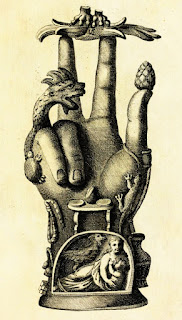

Possible magic item: Ornate statuette in the shape of a hand decorated with reliefs

Let me know

If you've tried this or something like it!


Other reading

Willful weapons and the trouble they cause: https://www.sjgames.com/pyramid/sample.html?id=1648

Interesting magic items: https://periaptgames.blogspot.com/2023/04/a-puzzle-from-1978-ad-1st-edition.html

Ideas for awoken magic items: https://githyankidiaspora.com/2015/04/20/wake-up-magic-items-wake-up-dccrpg/

A history of swords with ego: https://www.paulsgameblog.com/2018/01/28/ego-through-the-ages/

Difficulties with intelligent swords: https://www.tenkarstavern.com/2012/12/intelligent-swords-in-ad-1e-whats-with.html

Sapience in AD&D: https://periaptgames.blogspot.com/2023/04/a-puzzle-from-1978-ad-1st-edition.html


Sunday, 6 August 2023

Steps to a Hero (end of the campaign)

Do you want fantasy characters who have deep ties to their world? Backstory that directly affects mechanical traits? A fun, fast, unique character creation minigame?

We're down to the last 24 hours of the Kickstarter campaign for Steps To A Hero. It's the 125+ page book implementing a lifepath character generation system designed for compatibility with D&D 5e!

Thanks to everyone who's already supported the project!

Book preview pages


What's a lifepath?

A lifepath is a unique tool for producing a roleplaying game character, beginning them early in life and setting them down a path to become the person that the player will begin the game with. It tells a story about how a character came about, replacing the common process of generating race, background, ability scores, and other traits.

A lifepath is a process of discovery, and each step on the path is an event, decision, or encounter which will reveal things about your character – generating both backstory and game-mechanical traits as you go. Everything in the book is streamlined for 5e, overriding or complementing parts of the base game.


What's in the book?

In Steps to a Hero, you’ll find

  • Everything you need to develop characters with lifepaths for fifth-edition fantasy roleplaying
  • 300 unique lifepath 'steps', each one combining a piece of weird/medieval fantasy short fiction and corresponding character traits
  • A comprehensive set of rules describing the lifepath process, plus optional rules for tweaking character generation
  • A ton of 5e game content including hundreds of new background features, and methods to make many millions of possible stories and backgrounds
  • Support for 12 ancestries, including all the classics, plus half-djinni, half-minotaur, half-dryad, and shorewalker
Discover the remarkable story of each character’s early life, and determine how those experiences gave them the unique abilities and traits in their background.
 
A journey of a thousand miles begins with a single step. Venture forth!

Monday, 10 July 2023

Jade Perida: A 5e character made using lifepath generation

The Kickstarter campaign for my new book is three days in and has reached its funding goal. Today I'm sharing a 5e fantasy character created with the Steps to a Hero system.

The book has several ways to randomly generate character ancestries. For this one I used the balanced method, which has a small bias towards human ancestry. In today’s case, nine dice rolls gave us djinni and elf ancestry, and the story of someone's life.

Jade is not a physically brawny character, but a mental powerhouse. The uncovered story of her life is a driven and noble one. She set off at age 28 (young, for someone with elven blood) on a three-year journey.

Jade has one lifepath step from each ancestry, and another four steps that are events in her life. Jade is a bit of an outlier in that she didn't learn to use any tools over the course of her lifepath, but she ended up with plenty on her character sheet: lots of languages, skills, weapon proficiencies, starting equipment, and background features.

Steps to a Hero includes an optional rule for selecting a class based on the character's lifepath. In return for this constraint, a character can transfer a point from as many as five ability scores into one of their choice (to a cap of 19). We applied this rule and found that Jade is torn between Paladin, Wizard, and Cleric. Given her modest physical attributes and the righteous path in her background, Cleric is the obvious choice! The final step was to transfer a point from Intelligence to raise her Wisdom to 19.

You can follow along with the campaign to get more updates like this one.

Friday, 7 July 2023

Now on Kickstarter: A lifepath system for fifth edition fantasy!

Do you want characters to have deep ties to their world? Backstory that directly affects their mechanical traits?

We're crowdfunding the creation of a book that lets you create incredible characters using a uniquely tailored lifepath generation system. Click through to check out the project:


Lifepaths tell the story of a character’s early life, and let you discover how those experiences gave them the unique abilities and traits they start the game with. A lifepath is a process of discovery, and each step on the path is an event, decision, or encounter which will reveal things about your character.
​
We're writing Steps to a Hero, a 127-page book that will be available digitally or as a physical volume via print-on-demand. It contains tons of new game content, including 300 unique “steps” affecting a character’s ancestry, actions, and fortune, a lifepath system for combining those steps into millions of possible backgrounds, new background features, new ancestries, and more.

Back the book on Kickstarter to get a reduced price as thanks for your support in bringing the project to life!

Let's make character creation a journey of discovery!

Friday, 23 June 2023

Tarb, the Strife-heeled: Half minotaur, half orc, all brawn

Tarb is a Fifth Edition character built with my upcoming lifepath system.

Tarb is a distinctive fellow! Half minotaur and half orc, with the physical ability scores you would expect from those ancestries, he set off at age 18 and spent 11 years questing, standing guard, and sailing. Tarb’s lifepath is made up of three heritage steps (from his minotaur and orc ancestries) and three endeavour steps (from events in his early life).

This particular character ended up with lots of proficiencies and background features, but no tool proficiencies. A finalisation stage pruned back a few more features I rolled for him, and permits him to start with extra hit points instead. He knows two languages, and doesn’t start with much equipment. These traits are all the result of how his lifepath turned out.

By using an optional rule in Steps to a Hero, we can select a class for Tarb based on his lifepath using a points-based system. The class we end up with is Fighter! To build a powerful warrior, this rule also empowered us to transfer a point each from Intelligence, Wisdom, and Charisma to raise his Strength from 15 to 18.

If you want to be alerted when my Kickstarter begins, click through the banner below!


Tuesday, 20 June 2023

Book announcement: Steps To A Hero

I'm very excited to announce that my first major book release will be coming soon to Kickstarter.

Steps to a Hero introduces a lifepath system for character generation in 5e fantasy games, replacing the usual 'select and array numbers' process with a path where you discover how your character got started, their ties to the world, and how each step in their life so far influenced their abilities in the game.

If you're interested, you can follow along through this linked page!


Friday, 31 March 2023

Hints at an Upcoming Fantasy TTRPG Project

If you happened to be designing a life path system for DnD 5e, with say 300 steps, then you might determine the following.

The average ability score is 12.24 using roll-4-drop-lowest. Picking an ancestry usually gives you an overall +3, or a +0.5 per ability, for 12.74 total.

If each character has six steps on their life path to determine their background, then each step must give them about +3.75 ability score.

There are about 25 meaningfully different tool proficiencies, so if every other life path step offers a tool proficiency, each tool will be represented 6 times in a set of 300 steps.

Similarly, there are 18 skills, so by having life path steps typically offer choices between several different skill proficiencies, each skill can be represented at least 15 times in a set of 300 steps.

Common languages can be represented ~12 times and unusual languages ~8 times in 300 steps.

A character starting their life path should be at least teenaged, and a character starting play should be an adult, so six life steps should each confer at least 1 year of age on average (adjusted for ancestries with different lifespans and ages of majority).

Finally, something you might notice while writing 300 meaningful situations a character could find themselves in on their way to level 1 is that the 5e SRD list of tool proficiencies is quite incomplete. You would probably want to add at least miner's equipment, and you would be tempted to add tools for needlework, more specific metalworking crafts, and animal processing like butchery, chandlery, and soapmaking. You would certainly add more features relating to service roles!


Image and style editing with G'MIC

Let's look at G'MIC, the open-source image processing toolkit! I think we all benefit from a broad awareness of the powerful changes...