Showing posts with label character generation. Show all posts

Wednesday, 7 May 2025

Wiki Articles Are Wizards!

Wizards are bizarre uniquities who carve their own paths through reality like rogue stars.

Wiki Articles Are Wizards [citation needed] is my new zine for crafting these characters out of wiki articles, then pitting them against each other in a wizard-off!

To get a thematically consistent weird wizard with spooky powers and an appropriately unpleasant set of personality traits, you'll want to use procedural generation rather than strictly random generation. This small book gives you a comprehensive method for doing that, using wiki articles as the inspirational material, and has all sorts of bonus wizard-lore to boot.


🧙 Available today!


And I'm publishing a companion piece: a collection of troublesome characters, 30 Wicked Wizards!

From Miarthetrolut the Regulator (who meddles with fish kinematics) to Sthogar the Ambitious (and his reanimated giant spiders)!

The thirty wizards and archwizards in this zine-style book are all made using the Wiki Articles Are Wizards rules, all laid out in a splattery OSR style, and all very weird and wicked.


🧙 Also available today!


As well as print copies, you can get a digital edition of either zine!

Are you interested in both? Hey! You can grab the PDF bundle!


Wednesday, 16 April 2025

The retconned lifepath

I want to develop an idea about a novel RPG progression mechanic which was pitched here:

https://www.tumblr.com/alexanderwales/771838390587047936/pitchposting-retcon

The main idea is this: it's a narrative game where the majority of the gameplay involves placing the pieces of your own past.
[...]
So the whole game would be this: slowly adding to your own backstory, penning yourself in over time, until there's no room to maneuver anymore, and shortly thereafter, the game ends. The fundamental tension of the game is that you want to keep the character as amorphous as possible, to commit to as few details as possible, but commitment is necessary to actually accomplish things.
[...]
in this game "progression" does not come from increasing skills because you got better, it comes from defining the past.

I view this as an interesting twist on lifepaths.


Refresher: Lifepath mechanics

In TTRPG gaming, characters are classically generated by picking character elements (or clusters of them) from a set of options, supplemented with dice rolls to instantiate numerical attributes. Most games still do something in this vein.

A lifepath character generation system switches this up. Now you make early life decisions as your character, and/or roll to see what happened to them before gameplay began, and the outcome of that process is your character's start state.

(Aside: I made a comprehensive lifepath character generation book for D&D 5e which you can check out here: https://www.drivethrurpg.com/product/438774/Steps-to-a-Hero)


Lifepaths are an attractive alternative because they (can) restrict a player's decisions to only those of their character, not a bunch of things that their character was never in a position to choose themselves like their 'intelligence' stat. As a result,

  • They add more gameplay to the game
  • They feel more real
  • They reduce the pressure on the player to be creative
  • They replace the part of a role-playing game that has little to no role-playing (character generation) with a version that is mostly role-playing

Refresher: Retcon mechanics

Retcon is retroactive continuity. It's a broad category of ideas, and 'deciding parts of the past which were left undecided' is just one very narrow part.

The main RPG retcon mechanic I'm familiar with is the one Alexander Wales mentions in his pitch. Blades In The Dark, the GLOG, etc, permit a character by 'careful preparation' to retcon in things they have available to them, e.g., by carrying a bundle of unspecified equipment.

Outside of RPGs, something like this is a common part of story-telling games, where there are mechanisms for a player (as opposed to game master) to determine or replace parts of the world, often to the benefit of a character favoured or controlled by that player.


A possible synthesis

So we have this idea for, essentially, building a character by determining underdetermined bits of a lifepath.

➡️ Let's say characters all start at age 25, having had formative experiences since the age of 15, and initially have just one or two of their traits determined.

➡️ There's experience points, and you 'spend' xp at any time to declare how you 'spent' one year of your life (a nice little verbal correspondence).

➡️ Each year of your life grants you an appropriate character trait: an ability, skill, power, whatever.

➡️ Each trait you 'gain' in this way is, of course, one you've always had within the continuity of the game world. You're just revealing it now.

So you decide you spent a year traipsing the desert trade routes, and get increased endurance. Or you were pressed into military service as an archer, and are capable with a war bow. Or you spent a year repairing fishing trawlers, and have basic sailing and carpentry skills.

This setup allows for ten "level-ups", one for each adult / young adult year of your life prior to starting the game proper. You could tweak the time periods to get more buffer. If you do bump into the end game having 'spent' all your undetermined years, the game master would need to contrive a year-long time skip between adventures for the player characters to keep progressing, or switch to a different progression system.

Other than managing time, I see two main open problems. They're shared by most retcon / story-influencing mechanics:

  1. Things in the game world can / should be able to interact with your character's history before you're "ready" to determine it. When this happens, the choices are: do the character advancement early, contrive a way out of revealing (deciding) it, or suffer contradiction later on.
  2. When you do determine part of your character's history, it may make previous in-character choices and outcomes seem very stupid indeed. "You're telling me you apprenticed as an acrobat for a year? So have you been deliberately clumsy these last few weeks?"


Closing thoughts

By its nature, I think as a class of game mechanic this idea leans a bit towards the story-telling game end of the spectrum. It doesn't have many of the advantages of lifepaths which I mentioned.

It's a way for players to influence the overall narrative or game world more than their character's decisions. So I think if you were to develop it further, you'd be better off implementing it in a story-telling game or hybrid game rather than a 'strict' TTRPG.

Sunday, 13 October 2024

Discworld RPG: Makin' characters

For October I'm doing some Octobereviews! Last time I took an initial dip into the Discworld Roleplaying Game (powered by GURPS), by Terry Pratchett and Phil Masters. This time I let my fingers go all pruney by soaking for 143 pages:


Parts 2, 3, and 4: All the character stuff

The Discworldesque characters you can make with this book are intensely personality-focused, in a very detailed and mechanics-driven way. That's at odds with my normal outsider's conceptualisation of GURPS's grittiness as being angled towards its combat engine, and it's a pleasant surprise. I actually really like this focus on character personality; it makes perfect sense for the comic fantasy genre in general and Discworld in particular.

The rules are very, very detailed though. I'd be interested to see whether that gets in the way at the table; I've tended to disfavour mechanical character roleplaying rules for that reason, but I could see it working here.

Making a Discworld GURPS character isn't so different from making any GURPS character,* so I'll gloss over that in-depth process.

* But with perhaps slightly less focus on equipping them.

GURPS Discworld cover.


A little commentary on the big size question

It surprises me that a system as granular as GURPS doesn't just account for different character sizes as part of its fundamental maths. Everything about size in this book comes across as a workaround (e.g. short arms, p 96) or special case (falling damage, p 102) because the basic engine can't handle really small or big characters. A few things just don't work at all (gnomes "can't carry enough protection to provide any useful DR" even against gnome-sized attacks, p 256).

My impression is that GURPS focuses almost all of its simulation power on the parts of physics that are in the human spectrum. It makes me wonder how GURPS Supers works.

It's complicated further because

(a) you need very small characters to be playable;

(b) some very small humanoids on the Disc are disproportionately strong and durable, so rules that treat them as 'special cases' of human actually make sense...

(c) ...but others ones aren't

(d) from a gameplay perspective you need to prevent various extremely strong, large, durable characters* completely dominating all physical challenges and fights, as they would in reality.

* Well, not 'various'. Just trolls.

On a whim I checked the maths, and the writers got the troll weight implications right (p 107). Being 6.5 ft tall and 430 lbs means that if a troll is built similarly to a human, their flesh is about twice as dense per the rules, and indeed, stone is 2-2.5× flesh density in real life. A quick pass of the square-cube law says that the template sizes/weights (8 ft, 850 lbs; 12 ft, 4000 lbs) are also accurate. Kudos!*

* But again, it's GURPS, so you kind of expect this.

Making characters: The meh bits

It's GURPS, so whatever you thinking of character-building in GURPS, you'll think that here.

Interesting that we get 5 pages of dense text on vampires (pp 109-114) and the text still needs to say "use these other GURPS" books a lot. It feels like the authors were in a bind; vampires are notoriously heterogenous in folklore, and the Discworld novels explore a lot of that.

Note that male vampires can get 'Fully dressed resurrection' but female vampires can't (p 93); for some reason this gets repeated about five or six times throughout the book. It's an off-colour joke* which the authors seem to absolutely love.

* It's from the novels, of course, but doesn't go unexamined there.

I also found some of the GM advice on page 157 to be ham-fisted, but these are rare sour notes in the whole book.

Making characters: The good bits

We get rules for most Discworld-relevant trades, species, and archetypes. I can't think of a notable gap, and there were plenty (like Fourecksian Backpacker) which surprised me but are a good fit.

The writing is all very tight and well-edited. I made it through 162 pages without spotting a typo.

I'm pleased that the authors know the difference between "sapient" and "sentient" (p 106).*

* Star Trek has done unbelievable damage to this particular corner of the English language.

The equipment section is good, with an actually laugh-out-loud "10 foot pole" joke (p 156).

In the next part: Doing actual game stuff, and extensive thoughts on the magic system.

Sunday, 6 August 2023

Steps to a Hero (end of the campaign)

Do you want fantasy characters who have deep ties to their world? Backstory that directly affects mechanical traits? A fun, fast, unique character creation minigame?

We're down to the last 24 hours of the Kickstarter campaign for Steps To A Hero. It's the 125+ page book implementing a lifepath character generation system designed for compatibility with D&D 5e!

Thanks to everyone who's already supported the project!

Book preview pages


What's a lifepath?

A lifepath is a unique tool for producing a roleplaying game character, beginning them early in life and setting them down a path to become the person that the player will begin the game with. It tells a story about how a character came about, replacing the common process of generating race, background, ability scores, and other traits.

A lifepath is a process of discovery, and each step on the path is an event, decision, or encounter which will reveal things about your character – generating both backstory and game-mechanical traits as you go. Everything in the book is streamlined for 5e, overriding or complementing parts of the base game.


What's in the book?

In Steps to a Hero, you’ll find

  • Everything you need to develop characters with lifepaths for fifth-edition fantasy roleplaying
  • 300 unique lifepath 'steps', each one combining a piece of weird/medieval fantasy short fiction and corresponding character traits
  • A comprehensive set of rules describing the lifepath process, plus optional rules for tweaking character generation
  • A ton of 5e game content including hundreds of new background features, and methods to make many millions of possible stories and backgrounds
  • Support for 12 ancestries, including all the classics, plus half-djinni, half-minotaur, half-dryad, and shorewalker
Discover the remarkable story of each character’s early life, and determine how those experiences gave them the unique abilities and traits in their background.
 
A journey of a thousand miles begins with a single step. Venture forth!

Monday, 10 July 2023

Jade Perida: A 5e character made using lifepath generation

The Kickstarter campaign for my new book is three days in and has reached its funding goal. Today I'm sharing a 5e fantasy character created with the Steps to a Hero system.

The book has several ways to randomly generate character ancestries. For this one I used the balanced method, which has a small bias towards human ancestry. In today’s case, nine dice rolls gave us djinni and elf ancestry, and the story of someone's life.

Jade is not a physically brawny character, but a mental powerhouse. The uncovered story of her life is a driven and noble one. She set off at age 28 (young, for someone with elven blood) on a three-year journey.

Jade has one lifepath step from each ancestry, and another four steps that are events in her life. Jade is a bit of an outlier in that she didn't learn to use any tools over the course of her lifepath, but she ended up with plenty on her character sheet: lots of languages, skills, weapon proficiencies, starting equipment, and background features.

Steps to a Hero includes an optional rule for selecting a class based on the character's lifepath. In return for this constraint, a character can transfer a point from as many as five ability scores into one of their choice (to a cap of 19). We applied this rule and found that Jade is torn between Paladin, Wizard, and Cleric. Given her modest physical attributes and the righteous path in her background, Cleric is the obvious choice! The final step was to transfer a point from Intelligence to raise her Wisdom to 19.

You can follow along with the campaign to get more updates like this one.

Friday, 7 July 2023

Now on Kickstarter: A lifepath system for fifth edition fantasy!

Do you want characters to have deep ties to their world? Backstory that directly affects their mechanical traits?

We're crowdfunding the creation of a book that lets you create incredible characters using a uniquely tailored lifepath generation system. Click through to check out the project:


Lifepaths tell the story of a character’s early life, and let you discover how those experiences gave them the unique abilities and traits they start the game with. A lifepath is a process of discovery, and each step on the path is an event, decision, or encounter which will reveal things about your character.

We're writing Steps to a Hero, a 127-page book that will be available digitally or as a physical volume via print-on-demand. It contains tons of new game content, including 300 unique “steps” affecting a character’s ancestry, actions, and fortune, a lifepath system for combining those steps into millions of possible backgrounds, new background features, new ancestries, and more.

Back the book on Kickstarter to get a reduced price as thanks for your support in bringing the project to life!

Let's make character creation a journey of discovery!

Friday, 23 June 2023

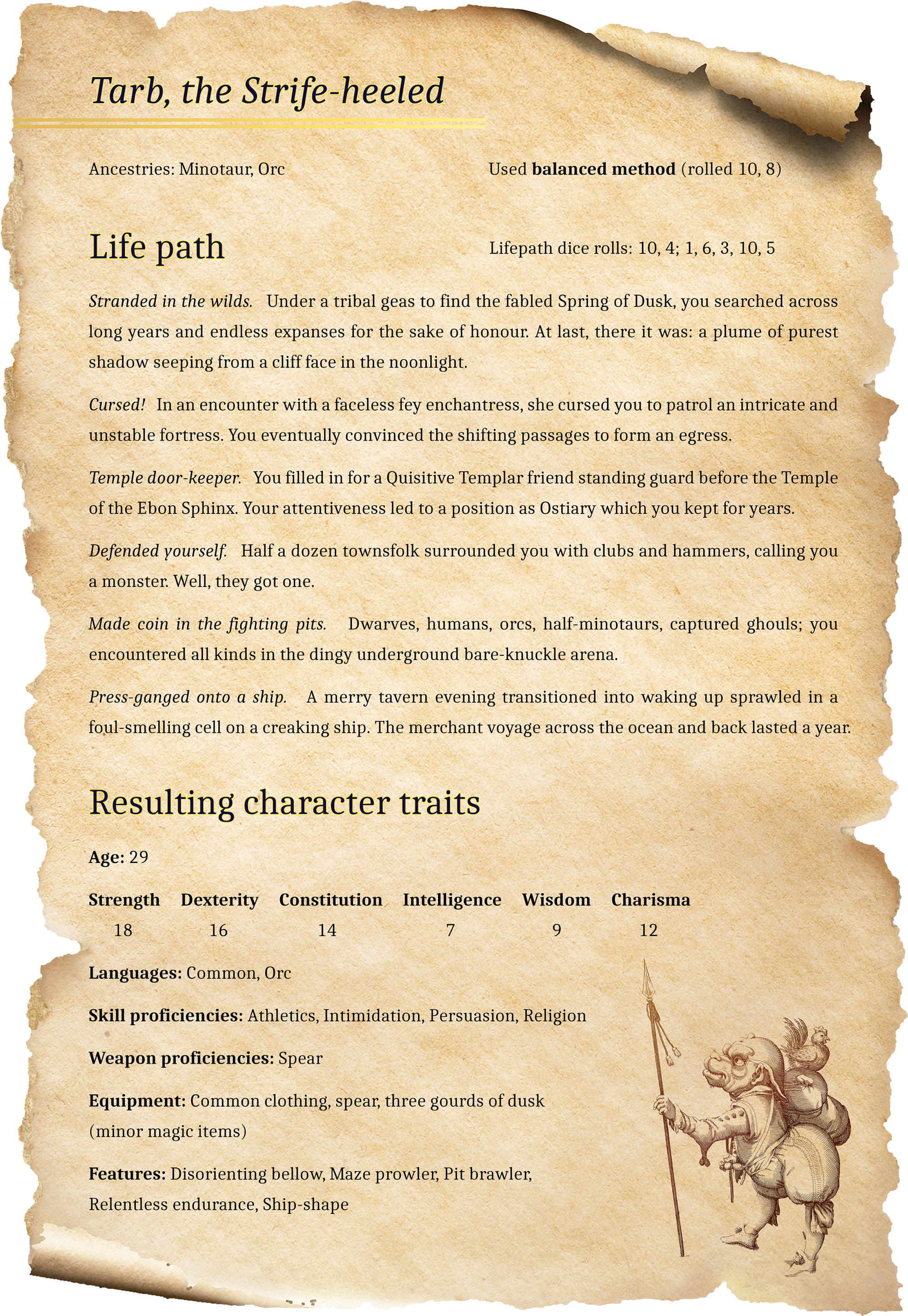
Tarb, the Strife-heeled: Half minotaur, half orc, all brawn

Tarb is a Fifth Edition character built with my upcoming lifepath system.

Tarb is a distinctive fellow! Half minotaur and half orc, with the physical ability scores you would expect from those ancestries, he set off at age 18 and spent 11 years questing, standing guard, and sailing. Tarb’s lifepath is made up of three heritage steps (from his minotaur and orc ancestries) and three endeavour steps (from events in his early life).

This particular character ended up with lots of proficiencies and background features, but no tool proficiencies. A finalisation stage pruned back a few more features I rolled for him, and permits him to start with extra hit points instead. He knows two languages, and doesn’t start with much equipment. These traits are all the result of how his lifepath turned out.

By using an optional rule in Steps to a Hero, we can select a class for Tarb based on his lifepath using a points-based system. The class we end up with is Fighter! To build a powerful warrior, this rule also empowered us to transfer a point each from Intelligence, Wisdom, and Charisma to raise his Strength from 15 to 18.

If you want to be alerted when my Kickstarter begins, click through the banner below!


Friday, 31 March 2023

Hints at an Upcoming Fantasy TTRPG Project

If you happened to be designing a life path system for DnD 5e, with say 300 steps, then you might determine the following.

The average ability score is 12.24 using roll-4-drop-lowest. Picking an ancestry usually gives you an overall +3, or a +0.5 per ability, for 12.74 total.

If each character has six steps on their life path to determine their background, then each step must give them about +3.75 ability score.

There are about 25 meaningfully different tool proficiencies, so if every other life path step offers a tool proficiency, each tool will be represented 6 times in a set of 300 steps.

Similarly, there are 18 skills, so by having life path steps typically offer choices between several different skill proficiencies, each skill can be represented at least 15 times in a set of 300 steps.

Common languages can be represented ~12 times and unusual languages ~8 times in 300 steps.

A character starting their life path should be at least teenaged, and a character starting play should be an adult, so six life steps should each confer at least 1 year of age on average (adjusted for ancestries with different lifespans and ages of majority).

Finally, something you might notice while writing 300 meaningful situations a character could find themselves in on their way to level 1 is that the 5e SRD list of tool proficiencies is quite incomplete. You would probably want to add at least miner's equipment, and you would be tempted to add tools for needlework, more specific metalworking crafts, and animal processing like butchery, chandlery, and soapmaking. You would certainly add more features relating to service roles!


Fantasy Fantasy League

  I've just released the full version of Fantasy Sports Fantasy League for pay-what-you-want! It’s more or less a TTRPG, but not like ...