Showing posts with label book. Show all posts

Monday, 27 April 2026

Meggs' history of graphic design: Reviewed

For the last couple of months I've been reading

Meggs' history of graphic design (fifth edition). Philip B. Meggs & Alston W. Purvis. 2012 revised (1998 original).

Book cover.

This is a 600-page book, with several thousand individually captioned images (I ran out of library renewals and had to rush, so didn't end up getting many pictures of them). Imagine a heavy encyclopedia crammed full of all kinds of visual design from history.

Structure 

There are so many overlapping movements, eras, styles, schools, and flourishings of (what would come to be called) graphic design. Meggs & Purvis choose to divide history into chunks, and their book into corresponding parts. Each part has a few chapters, each separately covering concurrent developments in different movements or countries.

Each section opens with a summary of the chapters it contains, in the form of a timeline. Useful for a reference book, although I only glanced at them in reading this book cover to cover.


Chapter opening spread for the book. Superimposed text and a timeline.

Production quality

Let's get a few issues out of the way first because there's a lot of good to say about Meggs' history! This was the longest and densest book I've read in a long time. It is expertly written and edited. The rate of textual errors per word is hundreds of times better than in some books I've read recently. I saw just thirty typos over the course of the entire work.

(Page 12, a full stop for a comma creates sentence fragments. Page 135, accidental line break. Page 136, 'either' in the wrong spot. Pages 224, 398, 482, and 553, "wich" for "which". Page 271, "has been" for "have been". Page 287, 'Figs' for 'Fig'. Page 290, unclosed parentheses. Page 350, redundant "also". Page 357, accidental sentence break. Page 389, "COBAL" for "COBOL". Page 417, "if" for "of". Page 479, "te" for "the". Pages 538 and 539, "florescent" for "fluorescent". Page 554, repeats the figure from the epilogue. Page 556, misapplied boldface.)

Curiously, 13 of these 30 errors occur in Chapter 23 specifically, giving the impression that the whole chapter missed the copyediting step:

Page 485, calls Japan "an island". Page 489, figure 23-16 is captioned as 22-16. Page 506, figures 23-77, -78, and -79 are called 24-77, -78, and -79. Page 508, "potography" for "photography". Pages 513 and 517, missing subheadings. Page 517, figures 23-113 and 23-114 are called 24-113 and 24-114. Page 521, misplaced comma. Page 529, "than that" for "to that".

I took issue with the block quotes, which are indented very similarly to the paragraph indent, use the same font, have no extra vertical space, and indent the following paragraph normally. Altogether this makes them hard to distinguish from the text. Fortunately the book only uses block quotes a few times.

Meggs' history usually prefers its figures to appear after they are discussed in the text. I dislike this because you can't properly understand text that is discussing an image you haven't seen yet.

Sometimes the figures appear in a different order to their textual references, e.g., 5-10 through 5-15, so it's puzzling that some full-page examples weren't just moved and renumbered to appear on the facing page to the textual reference.

I know from experience that laying out figures is extremely difficult. I wouldn't have mentioned the ordering, but it's made so much more of a hassle by the fact that...

The book has broken gutters!

One severe shortcoming made Meggs' history really hard to read.

At 600 pages, the hardback is so thick and heavy that when you open it on a table (unless you open it at the middle) the lighter side is lifted into the air. This makes ~30 mm of the page curve into the inner margin or "gutter". But the text columns continue to a margin of ~10 mm!

This is a huge obstacle to comfortable reading. On every line, at least one word disappears entirely into the gutter, and a couple more are distorted! It's even worse at the start and end of the book, where the curve of the pages is so pronounced that they obscure part of the opposite page!

I had to read this enormous book with two workarounds:

  • I can hold the thicker side of the book up vertically, putting my head down sideways to read those pages then sitting up to read pages on the lighter side normally.
  • I can press down really hard on a page on the lighter side while trying to read it (the book is so heavy that this requires both hands or the full weight of my arm).

This is completely stupid to begin with, and then the text constantly asks you to refer to a figure on a different page!

This issue affects all but the middle ~150 pages, i.e., this book cannot be read by opening it flat in front of you. The first note I made for this review called this a 'hassle'; now that I'm writing it up I'll upgrade that to 'accessibility nightmare'. It's frankly unacceptable and I can't understand how it happened.

Chock-full of content

Part of the allure of books like this are the graphic design examples. You could delight in it as a picture book, completely devoid of context. For example, there are some striking pieces by A. M. Cassandre (you can see more of his work catalogued here: https://www.moma.org/artists/1015-a-m-cassandre#works):

Telecommunications poster by A. M. Cassandre. Wires enter the ear of a person speaking.

But of course the book is meant to be about the historical discussion, which is very engaging (sometimes enrapturing) and comprehensive. The history of paper and printing in the first few chapters helped tie together a lot of areas in which I had vaguely known a handful of facts. Meggs' history traces the development of the written word from antiquity of Christian manuscripts, the throughline of Chinese printing to the Italian Renaissance, Celtic influences on Charlemagne's manuscript reforms (through English scholar Alcuin of York), and so on.

Here's an eye-opening fact. As of 1450, there were an estimated 50,000 volumes in European monasteries and libraries in total. In the next 50 years, with the advent of printing, nine million more books (35,000 editions alone) would be created. And that doesn't include printed ephemera (tracts, pamphlets, and broadsides), of which there were a lot. That's what a difference even early printing made in cost and production speed.

Meggs & Purvis give a concise explanation of the Industrial Revolution, discussing how it indirectly led to an explosion of typography and invention of 3D, decorated, and reversed fonts by typefounders in the early 1800s. The return to wood type for large display-sized printing (which metal was ill-suited to) was enabled by the invention of a new router in 1827 for producing the type. 

A few interesting specifics:

  • Some very familiar names popping up in discussing the people behind the typefaces: Bodoni, Baskerville, Playfair, Garamond, Caslon, Goudy...
  • I felt a certain kindred spirit in the authors' dissatisfaction with the numerous mistakes in the Book of Kells (~800 CE) juxtaposed to the "visual delight" of its "noble design" and "beautiful, carefully lettered half-uncials" (page 50).
  • The word "stereotype" originally comes from a printing plate production technique.
  • The first sans-serif font was by William Caslon IV, 1816, and called "two lines English Egyptian". These typefaces started spreading a decade later – but what to call them? Caslon used 'Doric' (presumably because a Doric column lacks the base and flourishes of an Ionic or Corinthian). Thorowgood said 'grotesque'. Blake and Stephenson, 'sans-surryphs'. The Boston Type and Stereotype Foundry, 'Gothics'. Vincent Figgins used 'sans serif' in 1832 and it stuck.

I especially enjoyed the chapter on the Art Nouveau movement and its various consequences for the West. I hadn't known about its roots in the ukiyo-e tradition ("pictures of the floating world") of Japan's Tokugawa period.

An Art Nouveau book layout. One part medieval revival, one part stylised colours, one part careful organic layout.

Art Nouveau disappeared in the ashes of WWI. Those numerous chapters on the early to mid 1900s were grim reading at times, even as all the different art and design movements of the era blossomed.

But history will remember Lucian Bernhard's adorable trademark and poster made for Hommel Micrometers (1912):

Logo. Little figure made from micrometer equipment.

Poster. 3D-seeming figure made from micrometer equipment, casting a shadow.

Also I don't care for the futurists, but check out this iconic book bound not with thread but enormous bolts. Fortunato Depero's Depero futurista, 1927:


Depero's famous "bolted book".


Tricky history

I was a little bit concerned by some mild whitewashing of history, or at least oversimplification of the kind that feels like a repackaging of high school history. It shows up regarding Charlemagne and the 'feudal system', and the intersection of Christianity with the Celts, areas where I've read a little bit from modern historians; I wouldn't be surprised if there's a lot more I didn't notice.

Also, Cadmus of Miletus may have brought the Phoenician alphabet to Greece, and possibly also killed a dragon then planted its teeth to grow an army, sure. The authors' hypothesis that "the power of Cadmus to raise armies from nowhere could have been due to his command of the alphabet" as "[t]roop movements, scouting reports, and orders from the field could be delivered by writing" (page 25) seems completely speculative for this quasi-historical figure.

There's a weird moment on page 434 where Meggs says "the memory of" a historic atrocity "was redeemed by the modern graphic design, architecture, and of course the fraternity of sports presented in the Olympic Games in Beijing". I hope this line is some kind of bizarre typo or fumbling for a word other than 'redeemed' because yeesh.

These are just the flies in the 600-page ointment, of course. Over all, the whole book appears to be extremely well-researched.

Modernity

I'm just barely old enough that I briefly had my hands on an electric typewriter when I was a kid, courtesy of my grandmother, although even then it was really only a curiosity. So I was tickled to see this: 

IBM advertisement for an electric typewriter.
Hanging punctuation (and hanging T crossbar) in an old IBM advertisement. The letters are tightly-tracked; is that an underscore or a really tightly-tracked ellipsis?

Meggs' history has some neat examples of electronically created collages from the 1980s as the predecessors of the digital graphic design revolution.

Chapter 22 covers postmodernism and the retro. It was neat, in a slightly recursive way, to dissect how designers started deeply examining the history of their art and calling back to famous bits of graphic design. I was tickled to see the book reproduce some of their works and then casually instruct the reader to turn back hundred of pages to see the sources they were inspired by. For some reason this feels fun even in a world of hypertext.

The fifth edition of the book adds a few chapters to take us all the way up to the early 2000s. By this stage I was burning the midnight oil to finish it, so I have few notes, but I enjoyed seeing the transition into the digital world, and a new explosion of graphic design possibilities and affordances on par with either Gutenberg or the Industrial Revolution. 

(Also shout out in passing to Exocet, the instantly-recognisable Diablo font.)

In summary 

I can't easily compare this to the other books on graphic design that I've read in 2026. Most of those have been modern and highly accessible instructional texts, not reference books. I will say, though, that it's refreshing to read a design book without constant textual mistakes.

Compared to the books on specific 20th Century areas of design, Meggs' history is obviously less able to get into all the fine details for a particular creator or movement so systematically, trading breadth for depth. But it still goes into detail for particular case studies, and is very professionally produced.

Meggs' history delivers stellar content but is a damn trial to deal with as a physical object. If I ever come into money, I will buy a copy of this book and have it cut up and expertly rebound in multiple volumes.

Wednesday, 27 August 2025

Out now: Monsters! Horrors & Abominations

 
My new book, Monsters! Horrors & Abominations, is now published!

It's a 215 page bestiary crammed full of weird and flavourful monsters for D&D 5e/2025, like the...
👹 Endlessphant (wrinkled grey elephant's leg with a million knees)
👹 Big scaly one (gormless rubbery hound-god of trolls)
👹 Void oyster (beautiful nacre-petrifying abomination from beyond the stars)
👹 Stillness mage (undead weather-worker and master of doldrums)


Streamlined for combat encounters and delivered with tactics information, modern design innovations, great illustrations, and a touch of humour! Between the base creatures and tons of variants, there are 240 monsters from Challenge Rating 0 to 20.

All focused on the unsettling, underground, unspeakable, unholy, and undead!

Now available here as a PDF or a neat hardcover book!

And as a blog reader, feel free to use this code for 10% off the PDF, or if you would like the hardcover, this code for 10% off the physical book!


Friday, 27 June 2025

Reviewn June 2025 part 3: Game books

In which I review the books I read in the first half of 2025

Part three: TTRPGs and game content


What games have I checked out in the last six months? Here I'm including published books and files, commercial or free, but not blog posts (which I read too many of).

It's Reviewn June!


Tiny Spaceship

An alien exploration to understand Planet Earth 

By Tanya Floaker (https://floaker.itch.io/tiny-spaceship)

A wholesome diceless three-page mini-RPG about a spaceship that's come to visit us, and the dangers it faces (from other players, in the roles of e.g. "a big flock of birds"). Has a beautiful cover by August Charters, and the layout is nice (although it would benefit from a proofread and a looser line spacing).

I appreciate the extensive endnote about inspirations and mechanical sources, and the use of CC0. 

Mechanically this is a collaborative story-building game with simple natural-language rules. The tiny spaceship plays off exploration (drawing attention to itself) against understanding (thereby resolving problems). With the caveat that I haven't yet played this, I would call it story-telling gaming done right: a game at a high level of abstraction should be fuelled by simple, abstract, broadly-interpretable rules. Looks fun.


RPG Design Zine 

A how-to zine about tabletop roleplaying game design

By Nathan D. Paoletta (https://ndpdesign.itch.io/rpg-design-zine)

Published 2019, it's 28 pages of quite abstract, but useful, advice. The thesis is "I'm not here to tell you which [design decisions] to make, but I do want you to know why you’re making them." That's largely borne out. The content covers pragmatic approaches to, and implications of, various design angles: articulating inspiration, interplay of structures, roleplaying-as-conversation, iteration, etc.

Overall, the zine doesn't align perfectly with my own conception of TTRPGs, but I found it all the more useful for that. For example, it makes some interesting points about granularity and utility, different to my usual approach of complexity is a cost you pay, and left me with lots to think about.

The scan quality had me squinting a few times. Corrections were made to the physical paper, which adds to the zine aesthetic, but a fair number of typos stayed in. Also, a lack of cite marks on the pasted text might have played well with the aesthetic, but meant the works cited list was less helpful than it could have been.

I'm looking forward to reading the 2025 edition to see how the author's approach has developed.


Sinister Hovering Orb

(Sinister Hovering Orb)

By David J Prokopetz / Penguin King Games (https://penguinking.itch.io/sinister-hovering-orb)

A single-page solo mini-RPG (plus title) which interested me because of the complete lack of strictly-flavour text: all the themes, implied goals, and flavour are purely wrapped in game mechanics. We have to learn the game to find out what it is about (to the extent that it can be said to be about something in particular).

For example, the reader discovers in the rules that they have four choices of activity/situation, used variously "when you are simply and suddenly present", "when your very presence brings down calamity", "when those who ponder you know what they must do", and "when you radiate a palpable sense of doom".

There are no player goals, high-level structures, rules about direction, best practises or suggestions to serve as connective tissue: only a series of game elements, presented with a sense of finality. I played a quick game and found it quite a compelling story generator, though a very open-ended one.


PUBLIC GUEST 5

Living With The Certainty of Death by the imminent explosion of our orbiting artificial planet PUBLIC GUEST 5

By Turtlebun (https://turtlebun.itch.io/public-guest-five) 

A solo RPG on a poster, with a delightful visual style. It's about, well, exactly what the subtitle says. It's a sort of journalling game, meant to be played a sentence at a time over the course of a long real-world period (probably about a month on average).

The diary mechanics are very simple, with two dice informing how you spend a week on your doomed world. When you roll boxcars, PUBLIC GUEST 5 explodes. (I broke the rules and played through in a single sitting, for a fairly melancholy experience.)

PUBLIC GUEST 5 and Sinister Floating Orb were interesting diversions. Together they're inspiring part of my approach to some upcoming projects which will explore themes of cosmic doom, inscrutability, inevitability, and loneliness.


Writing With Style

An editor's advice for RPG writers

By Ray Vallese / Rogue Genius Games (https://www.drivethrurpg.com/en/product/217525/writing-with-style-an-editor-s-advice-for-rpg-writers)

A 44-page book of advice for TTRPG writing. It had some tips and reminders I found useful. For someone without a background in technical writing, I bet this book is absolute gold.

There's plenty of generic advice, but plenty is specific to RPGs: sins to avoid (like read-aloud text that dictates the players' choices), lists of RPG-specific overused and confused words, writing to a game publisher's specification, etc. My only criticism is with the visual design: some odd typeface choices and the line spacing is too tight.

Worth the $5 on DriveThruRPG, especially for a new writer.


Dwarf Mine

A mapping game of adventure 

By James Hron / Paper Dice Games (https://paperdicegames.itch.io/dwarf-mine)

Perhaps not strictly an RPG, but a 25-page tabletop exploration game. You play as the location, and instead of levelling up, you add levels further down. It sort of feels like how Dwarf Fortress felt ~20 years ago: one plane, inscrutable dwarf characters, simple mechanics, inevitable doom, etc. But the cutaway is cross-section, not top-down.

There's a points (prestige) system for scoring, and a huge block of random tables. My trial game was quite enjoyable, and I definitely want to come back and give it a more thoughtful treatment.


The presentation has some rough edges, with typos, misplaced page references, inconsistent capitalisation, and the font size varying between tables.

A few of the rules could do with a rewrite:

  • I'm a bit confused about multiple attacks vs entering combat multiple times, with persistent enemies who attack back.
  • The connective geometry is mostly explained by example, not rules. Some of the rules contradict the examples, as in: "The walls of rooms, hallways, and ladders must all have at least a 1x1 square separating them", and also in "Rooms must be built in the orientation shown".
  • Goblin invasion mechanics seem underdetermined.
  • The appendix leaves the crucial word 'once' off the end of the sentence for Trap room. 

There's lots of neat mechanics, especially with the big monsters. I like that the Cave Wurm can damage the map itself.

The First of the Stone Folk puzzles me. It must be entombed in a 6x6 room – internal dimensions 4x4, so you only need to make 16 squares. Using 21 dwarves per square to minimise deaths, you will lose on average 168 dwarves. But I don't get the impression that total population is ever going to be over 100. Am I off the mark there? Or are you meant to wall this monster off really slowly? 

The dwarf leader ability adds a little more strategy. More inheritance tracking with the 'Bloodline' system would be interesting. I do like the idea of the Achievements list giving all future leaders a title. The room name generator appendix is clever, although wacky; you could get a barracks named "Bottom Watch" or a tomb named "New Trophy".

The author has written lots of official expansions and supporting content to keep the game fresh.


GURPS "Discworld Also"

A companion book for the original GURPS Discworld RPG

By Steve Jackson Games, Terry Pratchett, Phil Masters. Generally good, but most of the best stuff made it into the new edition (which I already read, and wrote some reviews for last year). So because I'll focus on the stuff that didn't, this review may sound more negative than I feel!

Sean Murray's illustrations feel quite Discworld-y, sketchy pen/pencil pictures that don't try to rip off Kidby's or Kirby's style. I like them. I'm not a fan of the book's layout, though. There's weird stuff going on with the kerning and text wrap. The column breaks are terribly confusing when there's a subheading (e.g., p 48 reads left to right then top to bottom, but p 49 reads top to bottom then left to right).

It's poorly copyedited for a professional product. For example, on just one page (29) I noticed

  • A mangled seven-clause sentence
  • "almost" should say "always"
  • "could" should say "would"
  • "fall off" should say "falling off"
  • "unaging" / "ageing" spelling inconsistency
  • "They not" should say "They are not"

The alternative troll stats, and the extra information on elfkin and gnolls is good to have. There's a nice robust peasant character template, with various background skills. We get a 'sentient animal' template, a disappointing miss on terminology (it should of course be 'sapient animal').

Translation of Discworld magic is done well. The additions are a bit uninspired, e.g. a magic item which replicates an air conditioner, with maybe a subtle joke about Maxwell's Demon.

The book provides some campaign settings. I mostly already read this content in the new edition GURPS Discworld RPG, with a couple of exceptions: Smarlhanger and Fourecks get more space here.

  • Smarlhanger is a frontier boom town in sheep country. It doesn't commit to some details ("there may or may not be changes made", p 86), which is frustrating in a setting guide. Lots of other details to work with though.
  • Fourecks cart races is a new subsystem, a spin-off of the GURPS Vehicles rules. The Mad Max pastiche from The Last Continent is fleshed out to a whole societal thing here. (It doesn't say so, but Fourecks definitely has a bunch of ultra-hardwood trees that would be used for the highest tier of armour.)

The book also has three adventures and three 'adventure seeds'. Again, I mostly already saw these in the newer edition. These seem pretty good, barring some vague patches.

'Walking the Spiral' is an adventure with an excellent idea: druids come to look for megaliths in Ankh-Morpork. (I really liked that the mouldering records were in the form of an ancient school essay.) The problem is that the implementation is painfully linear, with very little for the PCs to actually do until the setpiece fight. Especially if the druid emissaries are NPCs. The adventure also implies that the University's NPC wizards are perfectly capable of saving the day by themselves at the end, making this an adventure that doesn't need player involvement at all. The adventure premise is good enough that it's worth rescuing by redoing the structure, though.


Highland Vice

System-neutral Martian cowboy hexcrawl

By Strange Ian (https://ianstrange.itch.io/highland-vice) 

A 'kitchen sink' futuristic setting that meshes well. The concept: Mars has been scarred by poorly-thought out terraforming projects. It's reminiscent of Red Dwarf and Fallout and Futurama and Borderlands and Charles Stross, with extra Tibetan, Mongolian, Peruvian, Japanese, and Weird West elements. The goal is to find and retrieve a chunk of computer megabrain.

A 100-entry hexcrawl in 28 pages. With four hexes per page and system-neutral style, Highland Vice favours high-level terse description over gameplay details.

There's a great density of evocative ideas, which is what I want most out of content like this. An algae plantation heiress hunting with an overtuned laser rifle. The electromagnetic rail launcher used by wire-crowned shamans to send captives into orbit. A buried chest full of mismatched halves of different treasure maps. A hillbilly cyanobacteria moonshine shack guarded by a truck-sized amoeba. A monk riding a solar-powered robot turtle terrarium. An android executive assistant living for years impaled on a mammoth's tusk. A colossal mining engine meditating in the middle of a mountain, trying to free itself from the material. Gauchos duelling over a holographic pop idol in a field of cherry blossom. The primitive town built by a crashed trainload of plush robotic cuddle dolls.

Many of the hexes are linked, but some of the conceptual through-lines could be highlighted. For example, 'satellite shamans' come up in 0006, 0104, 0107, 0307, 0408, etc. If I ran this I'd make a quick setting overview using key concepts as subheadings, and add relevant pointers to/from each hex:

  • Satellite shamans
  • Teratorns, poebrothers, and other revived megafauna
  • Robot prosthetics
  • Hive drones 
  • Sky bandits
  • The Spinal War
  • Sindovar
  • The Maze 
  • Josung (game)
  • etc 

Definitely worth a look. It's recently published and free on Itch.
 

In progress

By my quick count, I have six different rulesets and splatbooks bookmarked and partially read. Possibly there's more, lurking in browser tabs or forgotten on the desktop.

I'd like to put some real effort in there. My ambition is that when I next fling reviews together, my "unfinished list" will be completely different!

Reviewn' June 2025 comes to a close.

So how'd I do? I didn't read as much as I hoped, but overall, not bad. For me, reviewing is ultimately about self-accountability, but hopefully you got something out of it.


Monday, 23 June 2025

Reviewn June 2025 part 2: Fiction books

In which I review the books I read in the first half of 2025

And pick out some ideas you could put in a game

Part two: Fiction 


It's Reviewn June! 

In the modern melange of media that blurs the line between traditional and web publishing, it's hard to say what's a 'book'. For the sake of a clean division, I'm looking here at the physical fiction books I read in the first six months of 2025.

...But now that I come to write them up, I find that means very few are left after I take out webfiction, manga, poetry collections on Project Gutenberg, books on archive.org, and ebooks. We're left with:


A bunch of John Allison's superb comic books

Maybe ten or twelve of them: volumes of Solver, Bad Machinery, Steeple, The Great British Bump-off, etc. Most of these I'd read in webcomic form; having them in print is a little luxury and a way to support a great artist. I wish that Conan and the Blood Egg hadn't been taken down since I'd have liked a physical copy of it. I also wish there was a nice, straightforward timeline of all of John Allison's creative outputs; he has a long history of different interlocking series and I have a completionist spirit.

Game-ready ideas: This stuff is just riddled with inspiration for modern settings. There's lots of semi-supernatural stuff going on. Especially check out the mystery-solving comics; you could lift one of the premises wholesale for a game of Kids on Bikes or maybe Fiasco.


Guards! Guards! (1989) and Men At Arms (1993). Terry Pratchett

Discworld re-reads after looking at GURPS Discworld last year, and reading GURPS Discworld Also this year. I've read every book in this series about a dozen times, apart from the last few. Pratchett in his best years remains unparalleled.

Guards! Guards! and Men at arms are comic fantasy detective books that I think anyone who likes even just one of those genres would enjoy.

Aside: I noticed there's a few lines in Guards! Guards! that appear almost verbatim in Shrek (the movie, not the book) in what one must charitably assume is convergent evolution.

Game-ready ideas: It's hard to make a comic fantasy TTRPG. Comedic elements develop in practise, at the table, unless everyone involved makes a dedicated effort to prevent that. Part of Pratchett's comic genius was taking ideas to their humorously logical ends (retrophrenology, the rate of million-to-one chances coming true in genre fiction, animal responses to their own reflections, etc).

I think 'taking ideas to their natural conclusion' always helps with verisimilitude, including in TTRPGs. Suppose X is a fantastic element true of your setting. Then you really ought to take what we know about how worlds / people / processes operate, puzzle out as many consequences that follow from X as possible, then add those to your setting or modify X to remove the ones you dislike. Otherwise some of these will inevitably be explored in play and come up short, revealing the world as shoddy papier-mâché.


Pick of Punch. William Davis (ed). (1975)

Punch had a surprisingly long history. I have a few of the really old compiled volumes, so old that they don't list dates (I'm guessing early 1900s), which I should dive into some time. This particular book is comparatively recent. It suffers from a boatload of unfortunate 'signs of the times' (racism, classism, misogyny...)

Game-ready ideas: Reading this was being immersed in British culture of a specific period; it was not always easy to parse. It's interesting that even things close to you in time (less than a century ago) and culture (English-speaking Commonwealth country) can end up almost incomprehensible; you don't need huge gulfs for a text's meaning to become eroded and for a different culture to seem strange. Corollary: If you pick up a book like this and discard the parodic and inappropriate elements, you'll be left with a mass of very specific setting content and tone you can borrow.


More

There's a few novels on my table that I have no hope of finishing before the end of June. Fingers crossed for getting them over the finish line by Christmas!

I may have to change how I approach reviewing in the long term, if my slow shift towards reading more digitally continues.

That's been especially true of my TTRPG reading, so next time, as I wrap up with part 3 (game books reviews), I'll be looking at digital publications too.

Saturday, 21 June 2025

Reviewn June 2025 part 1: Non-fiction books

In which I review the books I read in the first half of 2025

And pick out some ideas you could put in a game

Part one: Non-fiction 


I read a medley of materials.

The modern melange of media blurs the line between traditional and web publishing. Most books are available online; many bloggers edit their writing into self-published volumes; plenty of web texts are book-length or longer. News and commentary and user content and blog posts and tutorials and metafiction all start blurring together.

For the sake of a clean division, I'm only going to look at the physical books I read in the first six months of 2025. It's Review[i]n[g] June!


Five books piled up.
I externalise my memory by writing reviews every so often. 


Games and decisions: Introduction and Critical Survey. R. Duncan Luce & Howard Raiffa (1985)

A game theory textbook.

Do you ever dive into something thinking you'll be able to hack the technical writing because you have semi-relevant education? One of my majors was in formal logic, but I still couldn't really parse large chunks of this book.

Game-ready ideas: Any sufficiently technical work can be a good source of esoteric jargon to cram into a wildly different domain, like wizardry or mythos occultism or sci-fi engineering. By the way, a dryad and their tree are a dyad: https://en.wiktionary.org/wiki/dyad


A brief history of mathematical thought. Luke Heaton (2015)

An introduction to maths through a history lens. 

Brilliant, but dense going in parts. The rare book where I wish it had been twice as long so that some of the inferences and arguments could be laid out in more depth.

Game-ready ideas: Everything is weirder than you thought. 'Non-Euclidean' has a specific meaning which is not just synonymous with 'unknowably eldritch'. Geometry was useful to ancient societies for e.g. recalculating field boundaries after seasonal flooding moves markers. Mathematics has historically intersected massively with religion and spirituality.


Paradoxes from A to Z: Second Edition. Michael Clark (2007)

An encyclopedia of paradoxes with a weird design.

The gimmick is that the paradoxes are arranged in alphabetical order; this makes it almost impossible to read. The introductory entry on 'paradox' is under P, more than halfway through. The implication is you should be using this as a reference work, but the audience for that has to be miniscule! Reading it cover to cover, I was told constantly to flip elsewhere to get necessary background information, because of course all the formal approaches to paradoxes are interlinked. There are no page references. 😡

Seriously, why not just present the paradox in a sensible, mostly-chronological order? Introduce concepts as needed and build from there? Luke Heaton's book may have spoiled me.

Aside: It's interesting that many famous paradoxes are either resolved by the things mathematicians do to make mathematics useful (define countable and enumerable infinities, specify axioms of set theory, etc), or become trivial once you understand that human language isn't and can't be some perfect mirror of reality.

Game-ready ideas: I'm not a 'riddles' guy when it comes to puzzles. Don't use paradoxes for that. You could reskin some paradoxes as challenges that academics in a fantasy world are working on. Preference intransitivity might be turned into an interesting game challenge, e.g. some group prefers A > B > C > A under certain circumstances.


Zeus grants stupid wishes. Cory O'Brien (2013)

Myths from various cultural traditions, retold.

Absolutely redolent with early 2000s internet era writing style, down to ending with an insufferable take on science and religion. There's a line break after almost every sentence clause, like a text conversation or a certain type of free verse.

The author admits to having two orthogonal premises, and vacillates between them. Paraphrasing:

  1. "Modern retellings of myths are bowdlerised; I will tell you the weird nasty original bits [implied: and lean into the troubling stuff by making unpleasant jokes]"
  2. "I will just make stuff up to make myths more exciting"

Can't recommend it. I counted seven jokes that actually got a grin, out of (~20 'funny' lines × 275 pages) maybe 5500 stabs at humour. (Lots of typos, too.)

Game-ready ideas: When a cultural tradition is admired, it can end up reflected through massive gulfs of history into art, scholarship, etc. I also like (a) a more adversarial relationship with one's pantheon; (b) living in a magical gourd; (c) a sun that's capable of making mistakes and suffering retaliation for them.


Battle castles: 500 years of knights and siege warfare. Dan Snow (2012)

The story of a set of specific castles.

This was written in the wake of a TV series, and reads like television travelogue narration. The prose is sort of breathless and sometimes borders on legitimising tyranny (letting all the 'divine right of kings' slash 'conquering warlords should have a monopoly on violence so that they can govern' stuff go unexamined).

A useful primer on castles. The actual history content is decent, e.g., addressing the common misconception that a fight goes until you're dead or the enemy is wiped out. But I noticed a few absolute howlers too, old debunked canards like: "Beer was then a basic necessity of life because, unlike the water supply, it could be trusted not to cause disease."

Game-ready ideas: Castles are a specific response to a specific kind of socio-military-economic situation, and might not plausibly crop up in your fantasy world. If they do, there's enough info here you could just lift out a castle and its context entirely.


How to. Randall Munroe (2019)

Pop science with a twist: silly ideas taken seriously. 

'The xkcd guy' has written some books, and now I think I've read them all. Pretty light reading until the physics gets heavy. Covers how to play tag (against champion sprinters and marathon runners), how to power your house, how to decorate the world's tallest tree, how to land a plane on various surfaces, etc.

Fairly interesting stuff, but not the sort of thing that geared my mind up to go down some research rabbit hole. If I had any criticism, it's that it's a little America-centric.

Game-ready ideas: A lava moat is surprisingly near-feasible in real life, so in fantasy it should be even more of a staple.


AI Morality. Edited by David Edmonds (2024)

A modern collection of philosophical essays looking at AI and its implications.

The essays are about AI in the broad sense, not just 'generative AI' or 'LLMs', as people are increasingly misapplying the term (which is bewildering to me, like if some specific advancement in orthopedy for hockey injuries led to an explosion in popularity and people just started using the umbrella term 'medical care' to mean 'orthopedy for hockey injuries').

The book's anchors – philosophy, computer science, and writing – are at the intersection of my university study and brief academic career. I picked up a few places where a writer just obviously didn't know what they were talking about, but those were few and far between, so it didn't sap my respect for established academics too much. The book covers a lot of interesting topics, but I found myself skimming a lot due to the curse of existing familiarity with them.

Game ready-ideas: Nothing specific, but lots of inspiration for near-future science fiction. The ethics of insurance denial, cyberattacks, and Asimov's Laws. The chapters on faceless algorithms might be good for Cyberpunk / Shadowrun.


Tune in for Reviewn June parts 2 (fiction I've read) and 3 (game books I've read).

Saturday, 30 November 2024

TTRPG art on a shoestring budget

Here's a little general advice for indie game creators who can't afford all the art they want.

Stock art

If you have a little bit of money to use, stock art is cheaper than commissioned art and it's way easier to find what you need compared to trawling through commons (more on that later).

Understand and abide by licenses!

Artists license their art in different ways, with drastically different conditions. If all your art comes from one or two artists (or is all under particular licenses, like CC-BY), you'll save some headaches when it comes to complying with licensing terms and laying out credits.

An aside: I have found several pieces of licensed art where artists specify how they must be credited, and then the provided credit line has a spelling mistake or grammatical error. Should you fix it? I wouldn't personally risk it. I'm not a lawyer. I follow instructions.

I'm assuming you're not using AI material. Stock art creators are increasingly (and understandably) forbidding use of their work alongside it. Note that stock art websites don't do a very good job of tagging and filtering this stuff out!

  • Some, like Adobe Stock, are moderately diligent for mediocre results: exclude generative AI from a search and maybe one will slip through in ten pages of results.
  • Sites relying strictly on self-reporting, like Pixabay, are pretty much all saturated in untagged AI images. They've become practically unusable; you're basically reduced to searching in older time periods or within specific artists with a consistent, identifiable style.
  • DriveThruRPG also relies mostly on self-reporting, but I haven't seen many AI images passing themselves off as handcrafted.

Stock art directly from the creator

If there's a specific look/type of art you want, Patreon is one of the better sources, because you can support currently-active artists on an individual basis and at reasonable prices. I can't speak to whether or not it's better for the actual artists (I know they hiked their cut a little while ago).
 

An aside for Patreon artists: Please provide something like an actual license! It doesn't have to be long or detailed. It just has to make me feel confident that I am permitted to use your work for commercial purposes, can or can't advertise with it, won't be infringing on your moral rights, etc.

Open-sourcing your game art

So, on to doing it yourself! Lots of indie game makers have achieved great results by sourcing, compositing, and laying out their own art. Expect it to take a lot of work.

You'll probably have looked into public domain art. Specifically, works that have lost copyright status due to the amount of time that has passed since the death of their creator. If someone tells you a hard and fast rule for establishing this, they are wrong!

  • The "falls into PD" age differs between nations, there are all sorts of carve-outs, and even a photo reproduction may or may not be transformative. Don't rely on anyone but your lawyer for legal advice.

A lot of sites purport to collect and curate art "in the public domain". They almost always mean "in the public domain in the USA", and even if that's fine with you, they might be wrong, and even if they're right, they might not be conscientious. Check your sources!

Where can you get free-to-use art? Well, there's tons of places. Start with Wikimedia Commons, which is huge and usually quite accurately labelled with regards to sources and licensing (...but I have found errors before. Check your sources! Check your sources! Check your sources!).

Other sites for free art include: OpenGameArt, Pixabay, Pexels, Adobe Stock, various open clip art creators, and museums and libraries like The Met and the NYPL digital collections. All have their own foibles.

Understand that "free" doesn't mean "obligation-free".

I mentioned stock art licenses earlier. Learn what the various Creative Commons licenses do. CC0 (essentially a PD dedication) is the most generous, but fairly rare in the wild. As well as the license requirements, learn about and respect creators' moral rights. Credit people even when you're not required to by the license terms.

A lot of old PD art is unfortunately physically degraded. There are great pieces made unusable by age. Too bad. Don't waste time on things that are too small for your DPI, too faded or blurry, or too palimpsest'd. Understand that entropy is mostly irreversible. Or try tracing.

And know the value of your time. If you spent a hundred hours sorting through public domain art trying to find suitable works, and you didn't enjoy the process... would you have been better off just working for money and using that to pay an artist?

Good news

Anyone can be a competent collage artist by compositing, cropping, tweaking, and laying out PD / open license art. And digital tools stratospherically expand what the word 'collage' means. Have fun testing things!

The more you try things out, the more neat combinations you'll find. Sometimes even a very simple effect can make a serviceable piece of art out of something stylistically inappropriate.

For example, I had this old black-and-white John Batten illustration saved:


Black and White monster illustration.

I wanted to use it as the Nuckelavee demon in my current monster compendium (https://bit.ly/ancblasph). But it's a bit cartoonish, there's no colour to make it pop, and the solid white won't work against my backgrounds. It only takes six or seven trivial image operations to get something a bit more atmospheric:

Edited colour monster illustration.

I'm not much of an artist, but if I spent a bit more time on it, I could use more masks and curves and things to make this into a really crisp, vibrant piece.

Software

What tools should you use for image editing? I love FOSS in principle, and the people striving to make it work, but you do tend to get more or less what you pay for.

GIMP is perhaps your best free option, but it lags behind Affinity Photo (having no proper CMYK support, for example). APhoto in turn is cheaper than Photoshop, but lacks a few of its features.

You can do pretty much everything in a suite like Affinity Photo or Photoshop. But there are specialist tools for TTRPG-specific things (hexographer, inkarnate, etc), and their narrow focus may make them easier and more convenient than doing the same thing in an image editor.

Using these tools

What do you need to learn? I would say the ten basic concepts to familiarise yourself with are:

  • colour level/curve manipulation
  • selections
  • non-destructive editing
  • filters/adjustments
  • brush tools
  • geometry tools
  • perspective tools
  • touch-up tools
  • layers and layer modes
  • masks and clipping

There's plenty more, of course.

What do you need in terms of meta-level knowledge? Mainly, where to go for help. The internet is awash with tutorials. Start by reading/watching one of those, and then turn to searching/asking in the forums for your software.

Concluding thoughts

I started this by addressing those "who can't afford all the art they want". Again, don't forget that your time on Earth has value. If you have some exact image in mind, and it takes you 50 hours to assemble a pretty good version of it from diverse sources and painstaking image manipulations... then maybe you were better off paying an artist.

Except.

You're gaining skills as you go, and that alone may be worth it in the end. You're trying new things and making stuff.

Assembling other people's work in new ways is itself an art form, and constructing things from publicly available works may lead you to explore other ways to create.

There are side benefits, too.

Once you have the basics down, you can make your life easier by using your image manipulation tools to do mockups and visualisations. For example, I spent ten minutes this morning pairing up different candidate typefaces against different grungy/distressed visual styles in a scratch-built design, as in this snapshot:


Art, like everything in life, is a learning process. You'll find that you can cut some corners and not others.

And finally, if none of the above works for you, you could always Learn To Do Art Using Raw Materials yourself. I hear it can be very rewarding!

Wednesday, 20 November 2024

Monsters of the Month: Otherworldly Aberrations

The sky ruptures along some philosophical faultline and the sun splatters across the horizon like a dropped egg. There comes the distant dull crack of the cosmos breaking. Aberrant things begin to drip out of fissures in reality.

Fluorescent vermin with odd limbs come to graze on the verdant quiddity. Abominations fall from the flickering stars, and the world turns to mismatched bone and metal as they crawl by. There is something striding across the upper atmosphere, spindly legs higher than any tower. Space itself breaks open, and things feed on its viscera.

Divider.

Introducing the first in what should be a series of monster books for Dungeons & Dragons! This one is all about extraplanar and interdimensional beasties, like the Treader: an infinitely-long spindly leg dangling from the sky and traipsing about the landscape.

Banner image.

Inside this creature compendium, you'll find

  •     38 pages of bizarre monsters from CR 0 to CR 16
  •     Tactical advice for each monster
  •     Creatures crafted with modern D&D 5e design principles
  •     50 variant monsters for different environments and themes

Available now on DriveThruRPG!

Saturday, 12 October 2024

Monsters! Horrors & Abominations is on Kickstarter!

Can you ever have enough weird horrible monsters?

Are you ready for...

  • Sapient coral!
  • Were-angels!
  • Infinite sky legs!
  • Crooning rot!
  • Primeval lizard gods!
  • Undead swarms!
  • Void oysters!
  • Rule eaters!
  • Divine parasites!


This year has been spent hewing away at my new creation, Monsters! Horrors & Abominations, a hefty tome full of unique, flavourful monsters for use in your D&D 5e games. The whole book is designed for running combat encounters, with dedicated tactics advice, new traits and powers, encounter tables, a touch of humour, and tons of variants for each base creature!

Help bring the project to life on Kickstarter!

https://www.kickstarter.com/projects/periaptgames/monsters-horrors-and-abominations

Monday, 7 October 2024

Monsters! Horrors & Abominations

It's the Halloween season. And that means...

My new book, ‘Monsters! Horrors & Abominations’, is coming soon to Kickstarter! It's a 210+ page bestiary crammed full of weird and flavourful monsters for D&D 5e, like the...

👹 Endlessphant (wrinkled grey elephant's leg with a million knees)

👹 Big scaly one (gormless rubbery hound-god of trolls)

👹 Void oyster (nacre-petrifying abomination from beyond the stars)

All streamlined for combat encounters and delivered with tactics information, modern design innovations, great illustrations, and a touch of humour! Between base creatures and variants of them, we're looking at a total 240 monsters, ranging from Challenge Rating 0 to 20!


Unsettling, unspeakable things found underground, amidst the unholy and undead!

Follow along now on Kickstarter to get notified on launch!

Thursday, 22 August 2024

Something wicked this way comes

Somewhere in the abominable deeps...


Image of sharp monster teeth with the Periapt Games logo

A long-delayed project is nearing completion.

Watch this space.


Thursday, 23 November 2023

This month's writing

Here at Periapt Games I've just reached the first milestone on some fantasy monster design work for an upcoming book. The first milestone is "all the content is drafted". The second milestone will be getting through all the playtesting and ensuing revisions; third is finishing the supporting text and copy-editing; fourth is the layout being done; fifth is the art being finalised and proofs approved; etc.

(A major lesson in writing for production is that the actual writing is only a sliver of the process.)

What's my philosophy of fantasy monster design?

A monster should be easy to run. It should be plausible and/or fit a specific setting. It should be fresh. It should touch on classic tropes, but should also be weird. It should be easily tweaked or be presented alongside minor variations.

That means...

Aberrant grazers. Sorcerous byproducts. Creatures that lurk, beguile, and trap. Entities which warp the world around them. Small things made giant. Spells escaped from spellbooks and given form. Swarms which actually work the way they ought to. Monsters that are also transdimensional portals. The world's largest garden pest. Ethereal spirits lurking at the heart of permanently raging storms. And many many more.

And maybe whatever this thing is?

Hopefully I'll be able to share a more substantive update before the end of the year!

Sunday, 6 August 2023

Steps to a Hero (end of the campaign)

Do you want fantasy characters who have deep ties to their world? Backstory that directly affects mechanical traits? A fun, fast, unique character creation minigame?

We're down to the last 24 hours of the Kickstarter campaign for Steps To A Hero. It's the 125+ page book implementing a lifepath character generation system designed for compatibility with D&D 5e!

Thanks to everyone who's already supported the project!

Book preview pages


What's a lifepath?

A lifepath is a unique tool for producing a roleplaying game character, beginning them early in life and setting them down a path to become the person that the player will begin the game with. It tells a story about how a character came about, replacing the common process of generating race, background, ability scores, and other traits.

A lifepath is a process of discovery, and each step on the path is an event, decision, or encounter which will reveal things about your character – generating both backstory and game-mechanical traits as you go. Everything in the book is streamlined for 5e, overriding or complementing parts of the base game.


What's in the book?

In Steps to a Hero, you’ll find

  • Everything you need to develop characters with lifepaths for fifth-edition fantasy roleplaying
  • 300 unique lifepath 'steps', each one combining a piece of weird/medieval fantasy short fiction and corresponding character traits
  • A comprehensive set of rules describing the lifepath process, plus optional rules for tweaking character generation
  • A ton of 5e game content including hundreds of new background features, and methods to make many millions of possible stories and backgrounds
  • Support for 12 ancestries, including all the classics, plus half-djinni, half-minotaur, half-dryad, and shorewalker
Discover the remarkable story of each character’s early life, and determine how those experiences gave them the unique abilities and traits in their background.
 
A journey of a thousand miles begins with a single step. Venture forth!

Monday, 10 July 2023

Jade Perida: A 5e character made using lifepath generation

The Kickstarter campaign for my new book is three days in and has reached its funding goal. Today I'm sharing a 5e fantasy character created with the Steps to a Hero system.

The book has several ways to randomly generate character ancestries. For this one I used the balanced method, which has a small bias towards human ancestry. In today’s case, nine dice rolls gave us djinni and elf ancestry, and the story of someone's life.

Jade is not a physically brawny character, but a mental powerhouse. The uncovered story of her life is a driven and noble one. She set off at age 28 (young, for someone with elven blood) on a three-year journey.

Jade has one lifepath step from each ancestry, and another four steps that are events in her life. Jade is a bit of an outlier in that she didn't learn to use any tools over the course of her lifepath, but she ended up with plenty on her character sheet: lots of languages, skills, weapon proficiencies, starting equipment, and background features.

Steps to a Hero includes an optional rule for selecting a class based on the character's lifepath. In return for this constraint, a character can transfer a point from as many as five ability scores into one of their choice (to a cap of 19). We applied this rule and found that Jade is torn between Paladin, Wizard, and Cleric. Given her modest physical attributes and the righteous path in her background, Cleric is the obvious choice! The final step was to transfer a point from Intelligence to raise her Wisdom to 19.

You can follow along with the campaign to get more updates like this one.

Friday, 7 July 2023

Now on Kickstarter: A lifepath system for fifth edition fantasy!

Do you want characters to have deep ties to their world? Backstory that directly affects their mechanical traits?

We're crowdfunding the creation of a book that lets you create incredible characters using a uniquely tailored lifepath generation system. Click through to check out the project:


Lifepaths tell the story of a character’s early life, and let you discover how those experiences gave them the unique abilities and traits they start the game with. A lifepath is a process of discovery, and each step on the path is an event, decision, or encounter which will reveal things about your character.
​
We're writing Steps to a Hero, a 127-page book that will be available digitally or as a physical volume via print-on-demand. It contains tons of new game content, including 300 unique “steps” affecting a character’s ancestry, actions, and fortune, a lifepath system for combining those steps into millions of possible backgrounds, new background features, new ancestries, and more.

Back the book on Kickstarter to get a reduced price as thanks for your support in bringing the project to life!

Let's make character creation a journey of discovery!

Friday, 23 June 2023

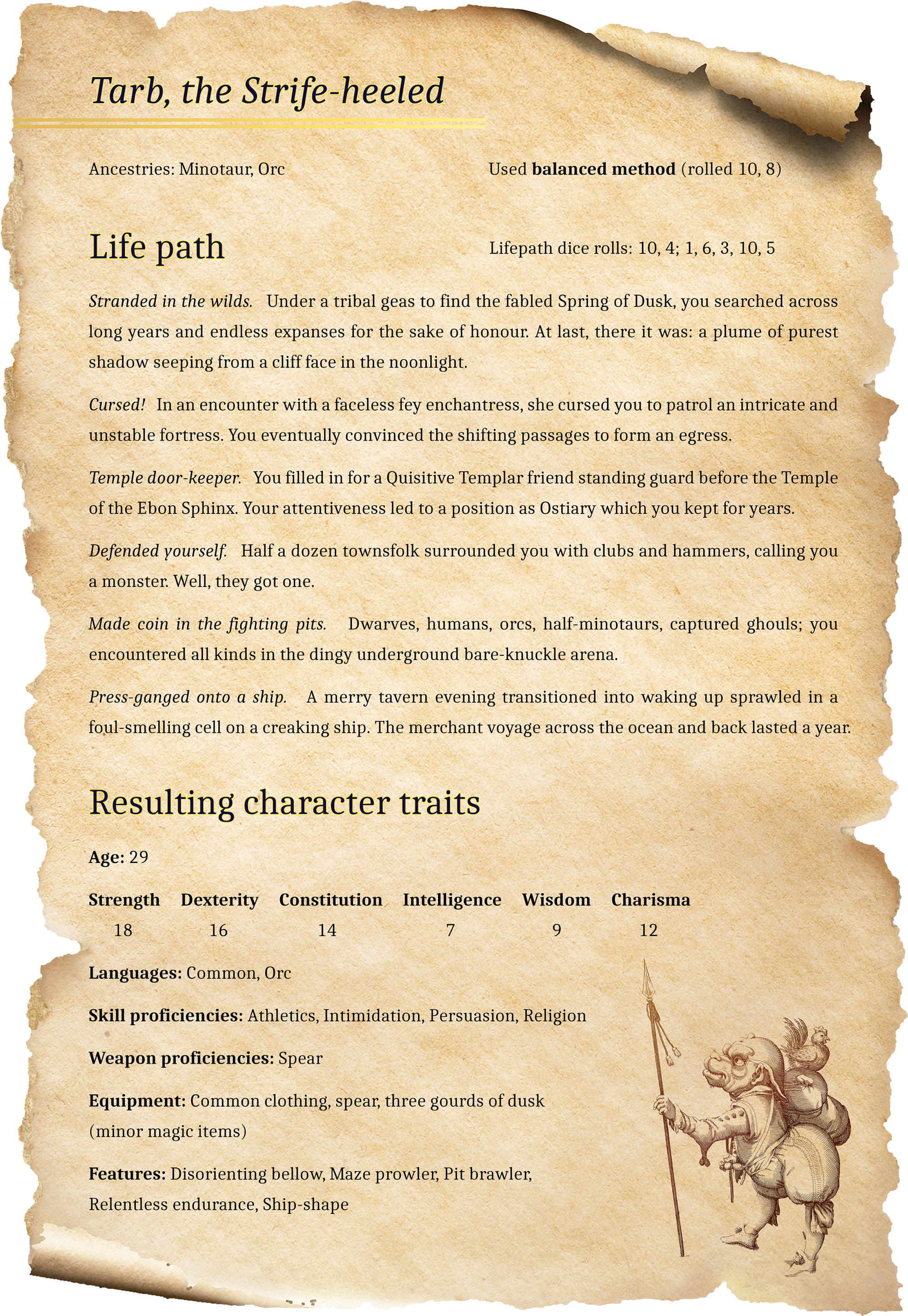
Tarb, the Strife-heeled: Half minotaur, half orc, all brawn

Tarb is a Fifth Edition character built with my upcoming lifepath system.

Tarb is a distinctive fellow! Half minotaur and half orc, with the physical ability scores you would expect from those ancestries, he set off at age 18 and spent 11 years questing, standing guard, and sailing. Tarb’s lifepath is made up of three heritage steps (from his minotaur and orc ancestries) and three endeavour steps (from events in his early life).

This particular character ended up with lots of proficiencies and background features, but no tool proficiencies. A finalisation stage pruned back a few more features I rolled for him, and permits him to start with extra hit points instead. He knows two languages, and doesn’t start with much equipment. These traits are all the result of how his lifepath turned out.

By using an optional rule in Steps to a Hero, we can select a class for Tarb based on his lifepath using a points-based system. The class we end up with is Fighter! To build a powerful warrior, this rule also empowered us to transfer a point each from Intelligence, Wisdom, and Charisma to raise his Strength from 15 to 18.

If you want to be alerted when my Kickstarter begins, click through the banner below!


Tuesday, 20 June 2023

Book announcement: Steps To A Hero

I'm very excited to announce that my first major book release will be coming soon to Kickstarter.

Steps to a Hero introduces a lifepath system for character generation in 5e fantasy games, replacing the usual 'select and array numbers' process with a path where you discover how your character got started, their ties to the world, and how each step in their life so far influenced their abilities in the game.

If you're interested, you can follow along through this linked page!


Image and style editing with G'MIC

Let's look at G'MIC, the open-source image processing toolkit! I think we all benefit from a broad awareness of the powerful changes...