Showing posts with label 5e. Show all posts

Wednesday, 27 August 2025

Out now: Monsters! Horrors & Abominations

 
My new book, Monsters! Horrors & Abominations, is now published!

It's a 215 page bestiary crammed full of weird and flavourful monsters for D&D 5e/2025, like the...
👹 Endlessphant (wrinkled grey elephant's leg with a million knees)
👹 Big scaly one (gormless rubbery hound-god of trolls)
👹 Void oyster (beautiful nacre-petrifying abomination from beyond the stars)
👹 Stillness mage (undead weather-worker and master of doldrums)


Streamlined for combat encounters and delivered with tactics information, modern design innovations, great illustrations, and a touch of humour! Between the base creatures and tons of variants, there are 240 monsters from Challenge Rating 0 to 20.

All focused on the unsettling, underground, unspeakable, unholy, and undead!

Now available here as a PDF or a neat hardcover book!

And as a blog reader, feel free to use this code for 10% off the PDF, or if you would like the hardcover, this code for 10% off the physical book!


Tuesday, 17 June 2025

Monsters of the Month: Malevolent Revenants

The crumbling monuments of the living are haunted by spiteful remnants. Rotted bodies stir in their catacombs and merge in shambling hordes. Powerful mage-wights linger under peat mounds, poring over parchment secrets.

Portents stalk the ruins, faceless dry flesh barely containing their wrathful spirits. In ancient sepulchres deep beneath the earth, towering warriors guard glittering treasures. Above them, the night's silence stutters with the cackles of bestial ghuls.
 

Monsters of the Month: Malevolent Revenants banner image.
 

Monsters of the Month: Malevolent Revenants

A collection of undead horrors, this is the last of the mini-bestiaries I'm putting out for D&D 5e/2025!

New monsters. Special traits. Tactics advice. Lots of variant forms.

Live on Kickstarter! 

Check it out here! https://www.kickstarter.com/projects/periaptgames/monsters-of-the-month-malevolent-revenants 

If you missed earlier collections, you can pick them up as add-ons!

Corpse prisons! Kitbashed bone golems! Toadstool-encrusted ghouls! Sear them with the light! 

Tuesday, 18 February 2025

What if every D&D power could be used at will?

Seriously, what would happen?

I think that in D&D 5e:

  • Resource tracking is fiddly, takes valuably game time, and isn't particularly fun.
  • The game's built-in resource management is one of its weakest design elements. So much hinges on the long rest mechanic that resources feel all-or-nothing. Between published adventure content and the relative lack of 'living world' rules under the hood, resting tends to be either impossible or unpunished, with little middle ground, depending on the situation. The DM gets little guidance on making it work.
  • Resource management decisions are only sometimes important, and seldom very engaging or fun, compared to the other decisions made during play. You learn good spells and tactics, and it's seldom important to change them. You may sometimes have intel leading to an opportunity to prepare differently, but the game isn't so difficult that doing so is necessary, and there isn't much in the way of DM guidance or built-in mechanics for getting intel into the PCs' hands.
  • Most of the game's rules are about tactical life-or-death combat, and therefore the game itself is about tactical life-or-death combat (although of course not everyone plays it this way). Trying to conserve resources in combat is a big gamble. After the particularly resource-limited early levels, play styles tend to converge on 'open with full broadside' and not be punished for that.
  • It is a game where characters don't just have 'powers' but extravagant superpowers, and it's highly character-focused.
  • Character classes all have a fairly similarly design, considered in the abstract. They get an array of at-will small superpowers plus various rate-limited superpowers, almost all of which can be used a low-single-digit number of times between rests. Other limiters on powers (e.g. HP or GP costs) are rare.
  • The game's balance is precarious and a DM needs to develop skill to tread the line between 'feeling dangerous' and 'being unfair'.

Let's say you mostly agree with these premises. I think it follows that making all D&D 5e powers at-will – that is, removing their rate limits...

  • Would remove part of the game, but not an important one
  • Wouldn't get rid of interesting choices
  • Would work for all classes without changing typical playstyles
  • Would lean into the existing superpowered and character-focused feeling of the game
  • Would make gameplay much faster
  • Wouldn't upset a perfect game balance that doesn't exist.

Spam spells all you like. Action surge on every turn. Put ki points on every attack; metamagic on every spell; enter rage or confer bardic inspiration whenever you can spare a bonus action.

Wizard summoning enormous demon. Photo via Adobe Stock.

This is an idle fancy – I've never seen it done. But I'd be fascinated to see how it played out. Extrapolating some consequences that seem plausible:

  1. The DM could then abandon CR and offer challenges which would otherwise be completely unfair, then see what the players come up with.
  2. If the DM created a 'too easy' encounter as a result, it wouldn't matter, because the power disparity and lack of resource tracking means the encounter gets settled in a fraction of the time that combat, spell-based trickery, or the various resource-conserving hedges usually take at the table.
  3. The DM could alternatively keep CR but remove all the rate limiters on adversaries' resources: recharges, dailies, slots, etc. (But unlike character classes, this would affect some creatures much more than others)
  4. PCs wouldn't need to keep lesser powers and spell choices for backup offense. With normal ideas of challenge abandoned there should be more situations where a particular utility spell or defence is desperately needed. That suggests that spell selection might become a more interesting decision!

Now, historically this sort of thing would lead to a worsening of 'linear fighters, quadratic wizards', but I don't think the difference would be as large in this edition of the game, at least before the highest levels. Fighters getting two actions every turn via action surge is pretty huge, for example. The biggest difference might be in high-level utility powers, the kind where you normally have one use of a valuable high-level spell slot and have to consider whether to save it for a fight. Now you could Fabricate or create a permanent Wall of stone every ten minutes, Mind blank the whole party, spam divination spells, and so on.

What other issues would you need to navigate?

  • A few character powers stop mattering. For example, second-rate but 'cheap' healing features are mostly obviated by having lay on hands or a decent healing spell. You might need to introduce some 'alternative features' available to all classes.
  • Some character powers would become irrelevant as the character increased in level. This wouldn't matter except that I doubt they're evenly distributed over character classes. You'd want to add a mechanic for swapping defunct powers out once you grow out of them, for those classes that don't already have one.
  • There are some slightly more or less resource-limited classes, and they become slightly better or worse choices respectively as a result. I don't think this matters except for warlocks, who deviate from the overarching class design patterns. They'd keep their major disadvantage (few powers) while everyone gets a better version of their major advantage (powers usable more often).
  • At the highest levels, powers (and spells especially) can become absurdly strong. But having poked around, I think only a few of them would be real trouble. It might literally just be Wish and Divine Intervention!
    • If you're abandoning material costs from spells as well as spell slots, you'd want to look at the few spells that are highly constrained by GP cost: Forcecage, Clone, Sequester, Gate, etc.
    • I might be wrong; maybe top-tier spellcasting really does outcompete other classes. You could make level 8-9 spells the sole exception to the 'infinite resources' rule, perhaps sticking to slots or limiting them in some other way (once per hour?).
    • Rogues would now get infinite Stroke of Luck as their capstone: their attacks always hit and their ability checks always succeed. I don't think this actually outshines having infinite spells, but it might be boring.
  • If the PCs' opponents also have no constraints, there might be a risk at high levels of the game devolving into win-initiative-to-win-combat, but hopefully it would lead to unique solutions.

Implications for the world

Obviously things would get absurd, especially if this is the norm for all people in the setting. But I already think the implied and official D&D settings don't actually develop most of the implications of the things that are canonically possible within them. All sorts of things (technologies, prices, lifestyles, community structures, social structures, etc) ought to look completely alien on the basis of low-level spells alone, and yet the setting (with its dramatic mixture of tech levels, dramatic mixture of society types, dramatic mixture of stakes, etc) stands unaffected.

But overall, losing even more immersion in a typical fantasy setting does strike me as a glaring issue, yes. Maybe abandoning rate limits would work in a more (post-)apocalyptic setting? One where everything is chaotic and in flux, where huge changes happen in the world very quickly, where absurdly spectacular powers are harnessed to mundane ends, and where nightmarishly powerful entities regularly make an appearance?

Saturday, 28 December 2024

Monsters of the Month: Mindless Devastation

My end-of-the-year monster collection for D&D 5e is funding now on Kickstarter!

This new 45-page compendium gathers tons of monsters under a single theme: swarms and other mindless rampagers. Hellbat colonies, malformed omens, dissolving hydras, swarms of undead leeches, star-seeded abominations, octopoid leviathans, and many more!

Book cover. Monsters of the Month: Mindless Devastation.


Check it out!

A group of burning fiendish figures. Illustration. Source: Adobe Stock.


Wednesday, 20 November 2024

Monsters of the Month: Otherworldly Aberrations

The sky ruptures along some philosophical faultline and the sun splatters across the horizon like a dropped egg. There comes the distant dull crack of the cosmos breaking. Aberrant things begin to drip out of fissures in reality.

Fluorescent vermin with odd limbs come to graze on the verdant quiddity. Abominations fall from the flickering stars, and the world turns to mismatched bone and metal as they crawl by. There is something striding across the upper atmosphere, spindly legs higher than any tower. Space itself breaks open, and things feed on its viscera.

Divider.

Introducing the first in what should be a series of monster books for Dungeons & Dragons! This one is all about extraplanar and interdimensional beasties, like the Treader: an infinitely-long spindly leg dangling from the sky and traipsing about the landscape.

Banner image.

Inside this creature compendium, you'll find

  •     38 pages of bizarre monsters from CR 0 to CR 16
  •     Tactical advice for each monster
  •     Creatures crafted with modern D&D 5e design principles
  •     50 variant monsters for different environments and themes

Available now on DriveThruRPG!

Saturday, 12 October 2024

Monsters! Horrors & Abominations is on Kickstarter!

Can you ever have enough weird horrible monsters?

Are you ready for...

  • Sapient coral!
  • Were-angels!
  • Infinite sky legs!
  • Crooning rot!
  • Primeval lizard gods!
  • Undead swarms!
  • Void oysters!
  • Rule eaters!
  • Divine parasites!


This year has been spent hewing away at my new creation, Monsters! Horrors & Abominations, a hefty tome full of unique, flavourful monsters for use in your D&D 5e games. The whole book is designed for running combat encounters, with dedicated tactics advice, new traits and powers, encounter tables, a touch of humour, and tons of variants for each base creature!

Help bring the project to life on Kickstarter!

https://www.kickstarter.com/projects/periaptgames/monsters-horrors-and-abominations

Monday, 7 October 2024

Monsters! Horrors & Abominations

It's the Halloween season. And that means...

My new book, ‘Monsters! Horrors & Abominations’, is coming soon to Kickstarter! It's a 210+ page bestiary crammed full of weird and flavourful monsters for D&D 5e, like the...

👹 Endlessphant (wrinkled grey elephant's leg with a million knees)

👹 Big scaly one (gormless rubbery hound-god of trolls)

👹 Void oyster (nacre-petrifying abomination from beyond the stars)

All streamlined for combat encounters and delivered with tactics information, modern design innovations, great illustrations, and a touch of humour! Between base creatures and variants of them, we're looking at a total 240 monsters, ranging from Challenge Rating 0 to 20!


Unsettling, unspeakable things found underground, amidst the unholy and undead!

Follow along now on Kickstarter to get notified on launch!

Thursday, 12 September 2024

Playtesting D&D monsters

I've been running quite a lot of playtests recently, so thought I'd talk about a few of the ins and outs of the process.

This is through a D&D 5e lens, but I suspect it generalises.

If you're planning to publish a monster, thorough playtesting is a must. It's not, sadly, a case of "run it once for your regular group's entertainment". You must run it until you have complete confidence in your work.

There are lots of design elements that you're going to need to juggle your focus on in playtesting, but we can group them into three main things:

  1. Double-checking the maths
  2. Ensuring it's fun
  3. Watching for corner cases

Cavern full of eyeballs.

Double-checking the maths

If you meticulously follow the D&D Challenge Rating rules in the DMG, you get a perfectly serviceable CR... As long as you can draw strong parallels between the monster's traits and those for which the book provides appropriate adjustments. For a trait that's really off the wall and you're not sure how large an effect it might have, playtesting becomes that much more crucial.

Particular things to keep an eye on:

  1. Monsters designed for very low or high CR. Low-level D&D characters are more vulnerable to individual dice outcomes; high-level characters can take advantage of synergies and have more options.
  2. Huge damage swings. A monster with a magic item that rolls 1d20 for 19 different cantrip effects and a ninth-level spell on a 20 might be balanced at a low-middle CR according to the mathematical averages. In practise, though, you're going to have one of two different unsatisfying play experiences.
  3. Offensive/defensive balance. As well as a monster being 'too easy' or 'too hard', being 'too arduous' to fight is also a design failure. D&D 5e (a) makes combat front-and-centre, (b) has a lot of fiddly rules for it, and (c) disincentivises players planning their turn before taking it. This adds up to a big risk of combat encounters dragging on. It's generally (although not always) safer to tweak the OCR higher and the DCR lower.
  4. Character optimisation. Creatures with book values are 'safe'. Starting players will on average have a good time fighting them, won't typically struggle at all with a level-appropriate Medium encounter, etc. Optimisers will take the same monsters and run them through the blender in a single round. There's no silver bullet here. In fact, there's no bullet. You simply have to balance for the 'default case' and then expect DMs to make changes to encounter design (or individual monsters) as necessary.

Ensuring it's fun

Monsters can be mathematically sound but boring to play. It's easy to come up with examples. Imagine a beast that negates a huge slew of character powers but can be readily whittled down with a steady barrage of normal attacks, while attacking once per round itself. Or one that hedges a specific character archetype out of the fight, while being unable to harm such characters. Or one that can only be engaged at range.

Judging the fun is the subjective bit of playtesting, and as hours and hours of combat turns pass, it gets harder and harder. Break up the work. Roll the dice instead of using average damage, just to see how it feels. Work out in advance how you're going to track player feedback on what feels satisfying and what doesn't.

Hopefully, you'll find sudden joy in stuff you didn't expect, and that will inform your work as a designer. The other day I tested a weak undead horde creature that I'd given an 'overkill' trait: a good enough roll lets the attacker kill it and cleave through into an adjacent creature of the same type. It turns out that kind of outcome, mowing down chaff with a single shot due to it being such a visibly fragile enemy, feels great for low-level characters who lack many special abilities for area damage!

Watching for corner cases

There'll be all sorts of things you didn't think of while designing. This creature is inorganic; it should be immune to poison. This creature appears in groups; it would be better off without the multiattack.

This creature's special power doesn't actually work as described... or lets it do this cheesy thing... or perhaps more commonly, it works fine, but you didn't describe it clearly enough for a DM to use. Get other eyes on your work as soon as possible (but that's a whole other article).

You won't find the problems if you don't actually examine the monster interacting with the existing rules, in a 'real' situation.

Playtesting is a big task...

...but it doesn't have to be a chore. Be organised, have a plan going in, intersperse it with other kinds of work, take joy from the emergent consequences as you would from a real game, and then the repetitiveness of it won't kill off all your fun.

Sunday, 21 January 2024

Improving Swarms for D&D 5e

As part of a creature project, I'm taking a look at improving the 'swarm of creatures' mechanics in Fifth Edition Dungeons & Dragons.

The problem is one of verisimilitude balanced against the quirks of the 5e combat system, and a desire to make swarms uniquely vulnerable to the things they should be vulnerable to while dangerous if you're fighting them without those things. Only fun solutions are allowed!

Animals swarming

What are the essential characteristics of a swarm?

A swarm of creatures is a notable opponent because each of its diminutive components is, almost by definition, (a) mostly harmless and (b) trivially defeated. Only en mass are they dangerous and require effort to destroy.

Characteristic 1: Weapons shouldn't matter, but strategies might

A lot of TTRPGs massively undersell the killing power of a bladed weapon compared to a blunt strike in almost all situations. One exception is fighting a swarm.

Typical swarms are made from creatures so small that the more effective approach to fighting them would be to hit them with something broad, in order to crush as many as possible at a time. If you have six seconds to spend and you're fighting a homogenous area of a thousand flying bugs in the space in front and to the sides of you, then we can imagine shooting an arrow might kill ~0.5% of the swarm if you're lucky, swinging a razor-sharp blade could kill ~1%, and swinging an ordinary dining chair could kill ~5%. If they're ground-based creatures, stamping on them or rolling around on them are likely to be far better strategies than swinging a weapon.

So if a player character wants to fight a swarm, then we only have to consider whether they're in melee or shooting at range; to simplify we might generously allow melee weapons to be as effective as unarmed or improvised attacks, so that players don't feel silly just having their characters stamp up and down every turn. Ranged attacks should be much worse, though.

As the swarm's component creatures become larger and more dangerous, the martial skill and physical power of the person fighting them might begin to matter. But for heroic fantasy like D&D 5e, I think we would generalise 'fighting skill and power' to 'character level': CR 18 swarms should be made up of individual creatures of a kind that any 18th level character can destroy trivially and in quick succession in a fight; the same creatures might individually pose a small challenge to 1st level characters, but the 5e design parameter of bounded accuracy limits the degree to which this can be true.

Characteristic 2: Big, flowing, and diffuse

A swarm is made of tiny little freely-moving elements, and therefore behaves something like a fluid: it can get into small spaces, surround creatures, and so on. Healing, strengthening, or weakening an individual creature shouldn't have any impact on the swarm.

How large and dense is a swarm of animals? Dense enough to see it clearly, as a bare minimum. In practise, I think it would be more viscerally horrible if it's really dense, with creatures crawling all over each other.

  • As a bare minimum density, I think we should imagine at least one flying bug in every 4×4×4 cm cube. Then we would have more than 15,500 bugs in a cubic metre, which is about the space you could swing a chair through.
  • Alternatively, we can imagine one larger flying creature like a small bird or bat in each 25×25×25 cm cube. There would be 64 such creatures in a cubic metre.
  • For a dense mass of beetles crawling over each other on the ground, we need at least one beetle every 2×2 cm. Then we would have at least 2500 bugs in a square metre.
  • Likewise, for rats or tarantulas or other larger creatures, I would expect at least one animal every 10×10 cm, for at least a hundred critters in a square metre.

I envisage swarms as having a big dangerous centre part and a much less dense 'periphery' of creatures that continually enter and leave the centre, but are mostly harmless. We can think of the swarm as being all the creature in it, but it's mostly the ones in the core attacking and grouped up in ways that makes it possible to kill them at any reasonable rate.

When I sit back and imagine a swarm, the whole thing must be at least five square metres on the ground, or at least ten cubic metres if flying – preferably much larger. Anything smaller seems pitifully small. Of that, the dangerous core is maybe a fifth to a half of its area (or volume).

This back-of-the-napkin maths implies you're fighting ~150,000 wasps or ~640 bats or ~12,500 centipedes or ~500 rats.

Dense swarm of insects

It's a good place for a reality check. Here on Earth...

  • A bat colony has several hundred bats
  • A honeybee swarm has 5,000 to 40,000 bees
  • A murmuration of starlings has 5,000 to 50,000 birds
  • Army ants form swarms or columns of between 200,000 and 20 million ants
  • A desert locust swarm is pretty diffuse, with 'only' 50 to 70 locusts per square metre but covering hundreds of square kilometres in total

Real-world swarms are probably much less dense than the ravenous fantasy swarms we imagine. But whether they are or aren't, the numbers don't seem off by multiple orders of magnitude.

Characteristic 3: Time required for attrition

Assuming a swarm is only dangerous because it is a very large group of marginally dangerous creatures, it should take a long time to destroy in melee combat.

If you have a six-second turn, maybe you can completely destroy half a cubic metre of flying creatures by swinging a chair through them, or annihilate a quarter of a square metre of ground-based creatures by jumping up and down on them. I actually think that's generous even for characters in a heroic fantasy genre.

Then with the parameters we've established it should take a minimum of 20 character turns to kill a swarm in melee (as a level-appropriate moderate challenge, 5 rounds for a party of four characters). For the kind of bigger, more dense swarms that we'd prefer, it 'should' take much longer to destroy a swarm without something that takes out a huge chunk out of it at once (see Characteristic 8, below).

Characteristic 4: Easy to hit

It shouldn't really be possible to try to harm a swarm and fail.

It doesn't matter if you're swinging an axe at bats or stamping on centipedes, we're talking about a packed area of low-intelligence creatures with little situational awareness, a flocking instinct, possibly driven into a frenzy, and surrounding their enemies on all sides. They're not getting out of the way.

In D&D terms, it shouldn't require an attack roll to take a swing at a swarm, and they should at least have disadvantage on most saving throws.

Characteristic 5: Dangerous in numbers

A swarm should be able to attack almost indiscriminately. Ideally, anything inside it should get hit; we might limit this to a 'multiattack' to make it faster.

As a swarm gets smaller, the amount of harm it can do should fall.

  • If a swarm takes up less volume as it suffers attrition, keeping the same density, then the number of targets it can attack simultaneously goes down.
  • If a swarm takes up the same volume as it is attrited, its density falling instead, then the amount of harm it does to each target goes down.
  • If a swarm's volume and density are both reduced, then you could justify either option.
Big angry ants


Characteristic 6: A reason for cohesion

The main reason (on Earth) that animals band together in swarm is to defend against predators. There's both 'safety in numbers' in the sense of an individual becoming statistically less likely to be predated, but also, the movements of the group can confuse or in some cases intimidate predators. There are rare exceptions, like army ants, which seem dangerous because they group up to hunt. I think it's safe to say that fantasy swarms are more like the latter.

A swarm sticks together, but clearly doesn't have to – its individual components aren't physically connected. It's a matter of taste as to whether parts that get separated can rejoin the swarm to continue acting in unison; I would rule that they can.

A swarm also can't react quickly or precisely or perform complex tasks, and its individual creatures attack pretty much blindly. In D&D terms, I wouldn't let it make attacks of opportunity: if you're in the swarm, you're being constantly bitten (with lots of miniscule harm adding up to HP worth of damage), and if you're not, you're not. If anything, a creature should suffer less harm for leaving the swarm's area sooner, but that's difficult to reconcile with D&D mechanics for only a small payoff.

Something is motivating the swarm to act as if it were a single creature. Maybe...

  • A true hive-mind has emerged from the swarm, or
  • A foreign overmind is controlling it, or
  • There's some spell or fantastical natural force in play, or
  • The individual creatures have a psychic bond

It seems likely that forcibly disrupting the swarm's cohesion would be particularly harmful to it. Depending on the nature of the outside motivator, the swarm might be particularly vulnerable to psychic damage, or it might shrug it off completely. I personally favour the former.

Things that affect a creature's physical body (conditions like paralysis, poison, and petrification) probably only affect one or a small number of bodies within the swarm, for negligible effect. We could model this as the minimum unit of harm in D&D, 1 hit point loss.

Characteristic 7: Extreme susceptibility to area damage

A little creatures which is individually below notice can be killed instantly by almost any attack. Some attacks are indiscriminate, hitting everything in an area. Even a really dense swarm probably has some room between creatures for such effects to penetrate.

It follows that effects like fire, force waves, toxic or corrosive clouds, rough weather, etc should do massive damage to a swarm. A swarm caught entirely within such an effect might struggle to survive at all! In D&D terms, it is not sufficient to model these kinds of things as different damage types. "6d6 poison damage to any creature in the cloud of poison" should kill a swarm; "6d6 poison damage to a creature hit by the arrow" should barely inconvenience it.


So does 5e capture these essential characteristics?

Not sufficiently, although the writers made an effort in that direction. Consider the six swarms in the D&D 5e System Reference Document (SRD).

Characteristic 1: Weapons shouldn't matter, but strategies might
Characteristic 7: Extreme susceptibility to area damage

SRD swarms do resist the kind of damage usually associated with weapons.

❌ ...But on average a longbow will still do more damage than a club, which will still do more damage than fists and feet, i.e., the opposite of what we'd expect.

❌ More martially skilled characters deal substantially more damage than less martially skilled characters when smacking at a SRD swarm in their space. We wouldn't expect this, especially at low levels (where flailing around with something broad and heavy to crush dozens or hundreds will always be a good strategy).

SRD swarms don't resist any of the classic area spell damage types, making damage spells a good choice against them.

❌ ...But nor do they resist single-target spell damage. And if an area spell does deal weapon-like damage, an SRD swarm takes half damage from it (which it really shouldn't).

Characteristic 2: Big, flowing, and diffuse

The SRD absolutely nails the 'Swarm' trait. I don't think it needs to change at all.

❌ The SRD swarms are Medium in size. Even if we imagine this as the most dense centre part of the swarm, this still feels too small for any but the absolute weakest of swarms (admittedly all the SRD swarms have a low CR).

Characteristic 3: Time required for attrition
Characteristic 4: Easy to hit
 

❌ The SRD swarms have similar HP to comparable SRD monsters, but their resistances effectively double it. However, their HP is unremarkable per the DMG monster creation rules, even factoring in resistances. They should be harder to destroy using single-target attacks.

❌ Likewise, their AC is typical for their Challenge Ratings, so a fair number of attacks (at least a third) will just miss them, even though that makes no sense.

Characteristic 5: Dangerous in numbers

The SRD swarms lose half their damage output when reduced below half health, calling to mind 4e's Bloodied condition. I think only changing it one time at half HP is reasonable. It means a swarm's current number of component creatures is directly reflected in its damage, but doesn't create more mental load for the GM with a more complex way of doing that.

❌ To have a SRD swarm attack lots of creatures at once, the GM has to fake it by using multiple swarms together. Really a swarm should be larger and dangerous to anything inside it. Think about the verb form of the word 'swarm'.

Characteristic 6: A reason for cohesion

SRD swarms are immune to most conditions, as we would expect. There are some edge cases like blinded, deafened, and poisoned which the designers let affect them (the first one possibly due to how light and obscuration are defined).

❌ Swarms probably shouldn't distinguish 'attacks of opportunity' from just continually attacking. Also, SRD swarms are affected normally by psychic damage despite being made up of hundreds or thousands of minds.


Owls and bats flocking together

Evolution of solutions

When I initially wrote a more plausible 5e swarm based on that analysis, playtesting showed that I'd gone too far in the direction of realism. The fun was being lost.

Swarms could be blown up by quite low level spells, and a combat run strictly with melee attacks was a grind: arduous but not very dangerous.

In 5e, combats that go beyond three rounds are uncommon, ones that go beyond four rounds are rare, and so on. When the four PCs took six rounds to destroy just one of three lower-CR swarms I knew I'd miscalculated. Out of a sense of morbid curiosity, I gamed out eleven(!) more rounds before the fight was over.

Fortunately, I found some tweaks that solved this:

  • Harmful area effects should do a lot of extra damage to a swarm (especially if all of it is in the area) without completely trivialising an encounter.
  • A melee attacker can't waste every turn inflicting really trivial damage on a swarm. (It's fine to make single-target ranged attacks useless, because 5e has no strictly ranged glass cannons, and the character types that come near that all have access to area damage.)
  • Swarms can have middling damage that drops when they hit half HP, as long as they deal some small damage on a miss, for an effect akin to a damaging aura.

With these changes, fights using just one or two spells last a good number of rounds. Multiple spellcasters willing to expend their best spell slot in their first turn can destroy swarms easily if they want to pay that cost. Fights with mostly mundane combat go longer than normal, but not outrageously so. More importantly, damage-on-miss makes swarms feel dangerous; between that and 'you can't fail to hit a swarm', the two sides are continually wearing each other down.

The final stat block isn't as completely verisimilitudinous as my initial vision, but overall it's a fun challenge to fight with a reward for thoughtful play, which is important. And the other changes to the SRD 'swarm' type monster implied by this article's analysis all worked well, so they'll be included in the final write-up.

Of course, to make this all hang together, the modified swarm needs a large number of traits (as well as some slightly unusual stat block entries like damage-on-miss and broad spectrum condition immunities). That's a no-no; it imposes substantial cognitive load on the GM, especially a GM trying to use it on the fly.

The next step, then, will be a challenge: Edit the text into a shorter form which presents the most important information in a way that's easy to find while keeping the writing crisp and clear. But isn't that always the case?

Monday, 18 September 2023

The hit point problem


...Or, what do HP actually represent (in traditional RPGs and their descendants)?


Dr Bret Devereaux's recent article on armour and RPGs, in talking about how armour actually works, reminded me about this argument. It's an argument that's older than the internet, an argument that's fundamentally pointless, an argument that's been rehashed thousands if not millions of times... so I thought I might as well get into it briefly.

Let's start here:

Hit points are a combination of actual physical constitution, skill at the avoidance of taking real physical damage, luck and/or magical or divine factors. [...] a near-miss, a slight wound, and a bit of luck used up, [...] more often than not a grazing blow, a mere light wound which would have been fatal (or nearly so) to a lesser mortal. If sufficient numbers of such wounds accrue to the character, however, stamina, skill, and luck will eventually run out, and an attack will strike home
- Gary Gygax, Dragon #24


It seems widely accepted, as well as being straight from the horse's mouth, that hit points are a mixture of a creature's capacity for and resilience against suffering injury ('meat points') and its chances, for various reasons, of avoiding serious injury in situations in which it might suffer serious injury ('grace points').

There's an implication that grace points are mostly 'used up' before meat points. And the obvious interpretation is that there's some (unspecified) ratio of grace to meat.

Unfortunately it's still impossible to arrive at a really self-consistent understanding of hit points in D&D-likes, whether you think HP is 0.1% meat and 99.9% grace, 99.9% meat and 0.1% grace, or anything in between.

HP must be almost entirely meat points, for the following reasons.

  • 1 damage to a 100-HP creature has to entail actual physical harm because it can come with 'riders' like injecting poison from a poison-tipped dart. If the dart didn't pierce the flesh 'on hit', it wouldn't have been able to convey the poison. At the other end of the spectrum, 100 damage is enough to kill the creature (or nearly so, depending on edition), so that too must be actual physical harm.
  • In trad games, higher Constitution improves HP (i.e., meat points). In comparison, Dexterity, Wisdom, and Intelligence (i.e., grace points) don't improve hit points at all, and neither do weapon/armour use skills and features (when they exist). If grace points made up a non-negligible proportion of hit points, having these attributes would affect HP total.
  • Numerous game effects, spells, items, and so on have descriptors that equate even potentially quite small amounts of HP recovery with descriptions of physical wounds closing. I would guess an outright majority of supernatural healing effects involve physical injury in their description, with most of the others being ambivalent or lacking description, and very few indeed talking about restoring anything that seems like grace points.
  • Plenty of damage in classic RPGs comes from sources that can't easily be mitigated (or can come from them in principle, for no special rules for when that happens). You character is stabbed while unconscious. Your character falls onto a field of spikes. Your character swims across an acid lake. Your character takes intermittent damage from rotting disease. The moisture is leached from your character's body by a horrid spell. In cases like these, half of the justification for 'grace points' can't be in play: the character isn't 'using skill to avoid harm', the damage isn't 'near-misses', and the character isn't just 'getting tired' or 'pushing their luck'. There are whole character archetypes unlikely to be protected by 'divine forces' or 'magical factors'.


Of course, it's also true that

HP has to be almost entirely grace points, for the following reasons.

  • When a 100-HP creature takes 99 damage, this doesn't seem to involve any actual physical harm: in classic games being down to 1 HP has no immediate in-game consequence on the creature (notable exception: D&D 4e's bloodied condition, and even then the effect isn't "a massive reduction in all of the wounded creature's physical capabilities" like you would expect). Per rules, the creature doesn't fall over or involuntarily scream or pass out from pain or anything. (And sure, the game rules are an abstraction, but the same RPGs will have other subsystems that are vastly more fine-grained than the idea that if you put a sword through someone, it has major traumatic effects.) There is never any indication that the GM is expected to improvise these consequences, either.
  • Martial characters get more hit points; they're the ones who are best able to avoid harm, because that is what all of their training is for. That harm avoidance is HP.
  • Characters gain hit points with level, at a rate that is vastly higher than remotely plausible variance in a person's actual ability to survive wounds. You could maybe convince me that some exceptional person could have twice as many 'meat points' as average. Three, four, five times? No way.
  • The same plausibility argument applies in general. A twelve-foot giant should weigh about 1500 lbs or 700 kg. If something like that swings an axe at you and it connects, the best you can hope for is that whatever gets lopped off is non-vital. Plenty of D&D-like games would model this attack hitting as something that can be slept off (depending on a damage roll, possibly). High-level characters might take dozens of such hits, depending on the game.


So we've immediately run into contradiction: some things in the game tell us that HP is almost all meat, and other things tell us that HP is almost all grace.


Side note

There's another reason we're unlikely to square the circle and find a self-consistent explanation in (most) HP-based games: Extreme injury.

Suppose 100 damage is just enough to kill some creature: It has 100 HP, or 90, or 90 and then flubs some rolls, or whatever. For this creature, 100 damage kills, so 99 damage is as close to a mortal wound as you can get. This amount of harm heals naturally, and perfectly, very fast, in almost every trad game I've ever seen. In modern editions, this near-mortal wound just goes away overnight! In contrast, I've personally had garden scratches that took a week to heal. Even in OD&D, the upper limit on healing is one month. That would be an optimistic timeframe for being discharged in a modern hospital after "a wound that very nearly killed you". That kind of wound would usually be the beginning of years of physical therapy, if not permanent disability.

COUNTERARGUMENT 1: We can concoct explanations for this, involving abstraction, and how much more survivable wounds are with modern medicine (or with fantasy magic), and how unfun it is to play out deadly infections or characters with degraded abilities, and how we don't want to require a player to play a character who's only definitely going to die rather than dead... sure. I've never heard one that's really comprehensive within the fiction, which is what I'm mostly concerned with.

COUNTERARGUMENT 2: Some games layer lingering injury frameworks, scar systems, etc, onto HP systems. This is fine, and sometimes works pretty well! I will note that in my experience they usually still don't go far enough to make for good simulation, and in particular these additional systems almost always still use a weird sped-up timeframe. I think they're also pretty rare on the whole, for traditional D&D-likes. I like em, though.

COUNTERARGUMENT 3: Some fantasy game worlds might be assumed to have low-level magical healing on tap everywhere, so a very slow trickle of hit points amounts to recovering your HP overnight (or 2d6/night or with one full day of bed rest or whatever). Sure, this works in principle. But I don't think many games come right out and say in their setting information that this is what's going on; it's hard to import into most worlds; it also precludes some genre features, like the existence of lingering injuries and old scars in the broad populace.


Finally, let's flip it around and consider actual practises at the table, where this matters. It's always been the case that certain rules get ignored or changed by swathes of gamers.

At the table, what GM ever describes a sword swing inflicting 10 damage as 'you nearly get hit' or 'they get a little tired jumping out of the way of the sword's arc' or 'fortunately for the ogre, your blade bounces off his belt buckle'? My impression is that this essentially never happens, in part because it makes a hit sound just like a miss, which is both confusing and a letdown.

What I do see, sometimes, is GMs being cautious and sometimes even vague about what is going on within the world – not really a sign that everything is as it should be in the game. They describe damage to enemies as flesh wounds (up until the moment it kills), and damage to characters as minor abrasions and bruises. They're careful not to imply any level of injury that would have actual game world impact (like impeding a creature's movement or making it leave a trail of blood) or later raise questions like 'you said I shattered his arm with that critical hit, how is he climbing the rope now?' or 'you said I was skewered by three arrows, how come I got better completely overnight?'

And likewise, I sometimes see GMs avoid describing the effects of magical healing as 'knitting together wounds', 'restoring all your blood', etc – and sometimes just not describe it at all – because that implies the character had been seriously wounded, and it somehow never feels like a character is badly wounded at the table, no matter how low their HP goes.

And in other cases, I see tables of players and GMs venture into absurdism, where HP loss is always a grisly wound described with relish; such wounds come and go entirely without any knock-on effects within the world, disappearing overnight.


Reconciliation


Is there a way around this without having to hack some extremely core game rules?

Solution 1: Embrace indeterminacy. Hit points don't really mean anything, and wounds are never described until the moment they are gone. If 50 lost hit points are immediately restored by a powerful healing spell then it may well have been a devastating wound (especially if the sufferer was 'dying' as per e.g. 5e rules), and the GM may feel free to describe it that way. But when a character suffers through an afternoon's adventure with 50 missing hit points and they get restored overnight, those ones were in retrospect obviously just a little fatigue (not enough to cause exhaustion), scratches and bruises (not enough to impede movement), and 'expended' luck or divine grace (whatever that means).

Solution 2: Play it straight. This fantasy world is different from our own because of its fantasy elements, and those fantasy elements officially include people's bodies operating utterly differently to how they do in our world. You can go from 'fifty-fifty chance of death' to 'top physical condition' overnight with no magical intervention because that's how it is in this universe. People of this world have no lingering injuries unless they were inflicted by one of the few extremely specific spells or powers that do that.

Solution 3: Beer and pretzels game. Just don't think about it.

Solution 4: It's meta. The game, in being played, produces a story of action in a heroic genre; all the bits of that story which don't make sense are because of (say) unreliable storytellers or other narrative tricks. At the moment it is happening at the table, nothing means anything; after the game, the resulting story is allowed to be inconsistent and impossible, because it's just a story. Yes, this undermines the very concept of roleplaying, so what?

Solution 5: It's stochastic. The lower a character's hit points – whether from injury or being fragile or low level – the more likely they are to die from the next attack. That's the only thing that 'HP' means. All attacks do little to no physical harm until the one that does: health and injury are a random walk on a line. More damaging attacks are both more likely to kill, and more likely to cause successive attacks to kill. And maimings, debilitating wounds, and true life-or-death situations cannot occur (presumably for one of the other four reasons above).

I don't think any of these solutions are very good. #1 is perhaps the most palatable, especially if it starts out hiding behind #3 as so seems more adequate once revealed.

Final thoughts

There's no good way to conclude because when it comes to 'what hit points mean' there's no conclusion to reach, no advice to give – hence the thousands or possibly millions of times something like this has been written or said before. These days I'm personally drawn to the idea of systems designed with something less abstract than hit points, as a way of making play experience more immersive, but, well, I think most players, most of the time, still like HP.

Sunday, 6 August 2023

Steps to a Hero (end of the campaign)

Do you want fantasy characters who have deep ties to their world? Backstory that directly affects mechanical traits? A fun, fast, unique character creation minigame?

We're down to the last 24 hours of the Kickstarter campaign for Steps To A Hero. It's the 125+ page book implementing a lifepath character generation system designed for compatibility with D&D 5e!

Thanks to everyone who's already supported the project!

Book preview pages


What's a lifepath?

A lifepath is a unique tool for producing a roleplaying game character, beginning them early in life and setting them down a path to become the person that the player will begin the game with. It tells a story about how a character came about, replacing the common process of generating race, background, ability scores, and other traits.

A lifepath is a process of discovery, and each step on the path is an event, decision, or encounter which will reveal things about your character – generating both backstory and game-mechanical traits as you go. Everything in the book is streamlined for 5e, overriding or complementing parts of the base game.


What's in the book?

In Steps to a Hero, you’ll find

  • Everything you need to develop characters with lifepaths for fifth-edition fantasy roleplaying
  • 300 unique lifepath 'steps', each one combining a piece of weird/medieval fantasy short fiction and corresponding character traits
  • A comprehensive set of rules describing the lifepath process, plus optional rules for tweaking character generation
  • A ton of 5e game content including hundreds of new background features, and methods to make many millions of possible stories and backgrounds
  • Support for 12 ancestries, including all the classics, plus half-djinni, half-minotaur, half-dryad, and shorewalker
Discover the remarkable story of each character’s early life, and determine how those experiences gave them the unique abilities and traits in their background.
 
A journey of a thousand miles begins with a single step. Venture forth!

Monday, 10 July 2023

Jade Perida: A 5e character made using lifepath generation

The Kickstarter campaign for my new book is three days in and has reached its funding goal. Today I'm sharing a 5e fantasy character created with the Steps to a Hero system.

The book has several ways to randomly generate character ancestries. For this one I used the balanced method, which has a small bias towards human ancestry. In today’s case, nine dice rolls gave us djinni and elf ancestry, and the story of someone's life.

Jade is not a physically brawny character, but a mental powerhouse. The uncovered story of her life is a driven and noble one. She set off at age 28 (young, for someone with elven blood) on a three-year journey.

Jade has one lifepath step from each ancestry, and another four steps that are events in her life. Jade is a bit of an outlier in that she didn't learn to use any tools over the course of her lifepath, but she ended up with plenty on her character sheet: lots of languages, skills, weapon proficiencies, starting equipment, and background features.

Steps to a Hero includes an optional rule for selecting a class based on the character's lifepath. In return for this constraint, a character can transfer a point from as many as five ability scores into one of their choice (to a cap of 19). We applied this rule and found that Jade is torn between Paladin, Wizard, and Cleric. Given her modest physical attributes and the righteous path in her background, Cleric is the obvious choice! The final step was to transfer a point from Intelligence to raise her Wisdom to 19.

You can follow along with the campaign to get more updates like this one.

Friday, 7 July 2023

Now on Kickstarter: A lifepath system for fifth edition fantasy!

Do you want characters to have deep ties to their world? Backstory that directly affects their mechanical traits?

We're crowdfunding the creation of a book that lets you create incredible characters using a uniquely tailored lifepath generation system. Click through to check out the project:


Lifepaths tell the story of a character’s early life, and let you discover how those experiences gave them the unique abilities and traits they start the game with. A lifepath is a process of discovery, and each step on the path is an event, decision, or encounter which will reveal things about your character.

We're writing Steps to a Hero, a 127-page book that will be available digitally or as a physical volume via print-on-demand. It contains tons of new game content, including 300 unique “steps” affecting a character’s ancestry, actions, and fortune, a lifepath system for combining those steps into millions of possible backgrounds, new background features, new ancestries, and more.

Back the book on Kickstarter to get a reduced price as thanks for your support in bringing the project to life!

Let's make character creation a journey of discovery!

Friday, 23 June 2023

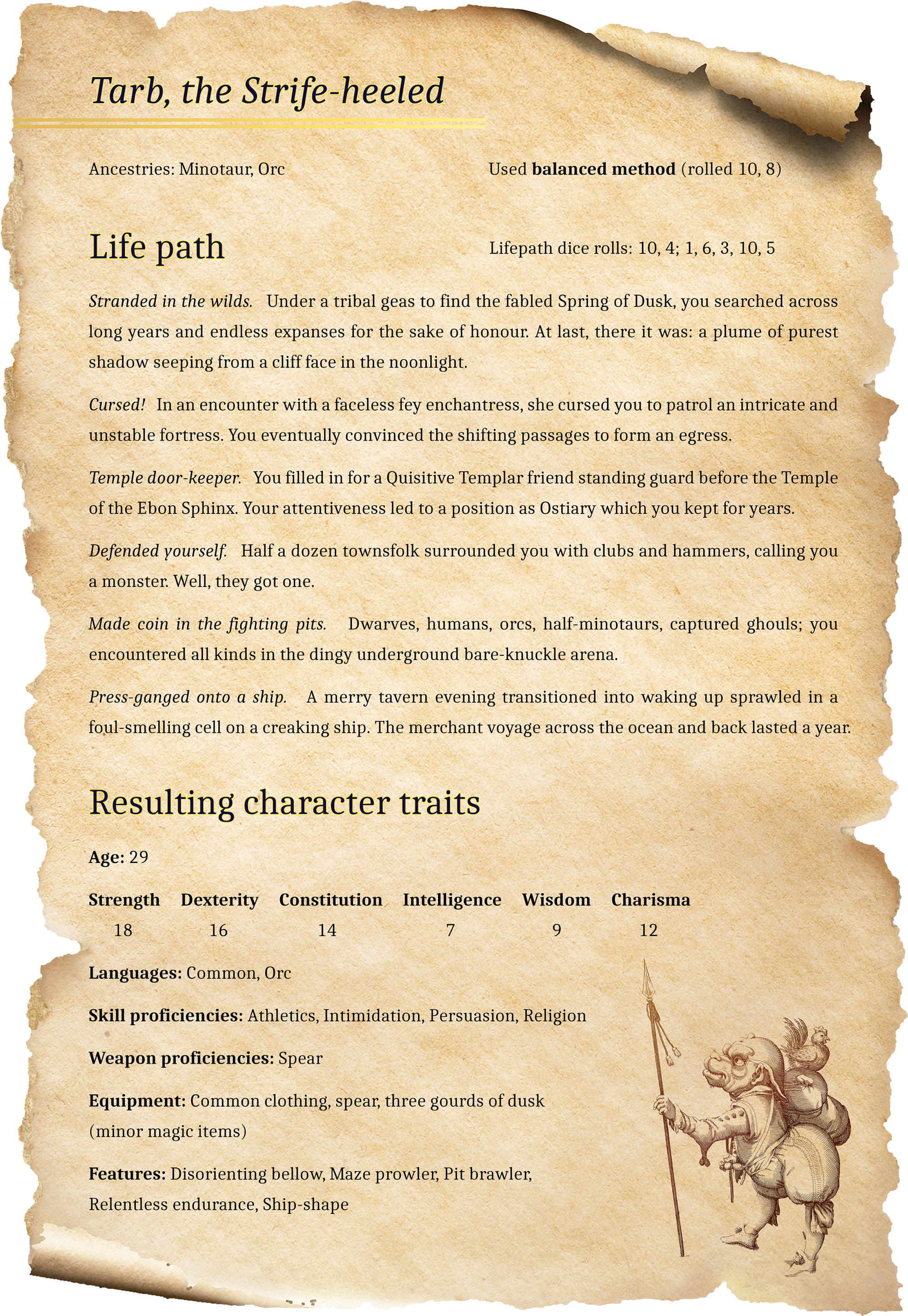
Tarb, the Strife-heeled: Half minotaur, half orc, all brawn

Tarb is a Fifth Edition character built with my upcoming lifepath system.

Tarb is a distinctive fellow! Half minotaur and half orc, with the physical ability scores you would expect from those ancestries, he set off at age 18 and spent 11 years questing, standing guard, and sailing. Tarb’s lifepath is made up of three heritage steps (from his minotaur and orc ancestries) and three endeavour steps (from events in his early life).

This particular character ended up with lots of proficiencies and background features, but no tool proficiencies. A finalisation stage pruned back a few more features I rolled for him, and permits him to start with extra hit points instead. He knows two languages, and doesn’t start with much equipment. These traits are all the result of how his lifepath turned out.

By using an optional rule in Steps to a Hero, we can select a class for Tarb based on his lifepath using a points-based system. The class we end up with is Fighter! To build a powerful warrior, this rule also empowered us to transfer a point each from Intelligence, Wisdom, and Charisma to raise his Strength from 15 to 18.

If you want to be alerted when my Kickstarter begins, click through the banner below!


Tuesday, 20 June 2023

Book announcement: Steps To A Hero

I'm very excited to announce that my first major book release will be coming soon to Kickstarter.

Steps to a Hero introduces a lifepath system for character generation in 5e fantasy games, replacing the usual 'select and array numbers' process with a path where you discover how your character got started, their ties to the world, and how each step in their life so far influenced their abilities in the game.

If you're interested, you can follow along through this linked page!


Friday, 31 March 2023

Hints at an Upcoming Fantasy TTRPG Project

If you happened to be designing a life path system for DnD 5e, with say 300 steps, then you might determine the following.

The average ability score is 12.24 using roll-4-drop-lowest. Picking an ancestry usually gives you an overall +3, or a +0.5 per ability, for 12.74 total.

If each character has six steps on their life path to determine their background, then each step must give them about +3.75 ability score.

There are about 25 meaningfully different tool proficiencies, so if every other life path step offers a tool proficiency, each tool will be represented 6 times in a set of 300 steps.

Similarly, there are 18 skills, so by having life path steps typically offer choices between several different skill proficiencies, each skill can be represented at least 15 times in a set of 300 steps.

Common languages can be represented ~12 times and unusual languages ~8 times in 300 steps.

A character starting their life path should be at least teenaged, and a character starting play should be an adult, so six life steps should each confer at least 1 year of age on average (adjusted for ancestries with different lifespans and ages of majority).

Finally, something you might notice while writing 300 meaningful situations a character could find themselves in on their way to level 1 is that the 5e SRD list of tool proficiencies is quite incomplete. You would probably want to add at least miner's equipment, and you would be tempted to add tools for needlework, more specific metalworking crafts, and animal processing like butchery, chandlery, and soapmaking. You would certainly add more features relating to service roles!


Saturday, 4 February 2023

Melee combat abstractions: Time

Games necessarily use abstractions. Abstractions are neither good nor bad, although there can be good or bad implementations, and when choosing levels of abstraction for different elements, there can be good or bad choices.

Some things true of pre-modern armed combat which might not be obvious to everyone are:

  1. When combatants are in reach/measure, strikes can be delivered very fast, and 
  2. Combatants can spend a lot of time out of reach/measure, sizing each other up.

Many tabletop game designs get this backwards. There is almost never an incentive to stay just out of fighting range. And strikes in reach are either

  1. Modelled individually, in which case the system almost always permits too few of them; or
  2. Modelled abstractly/collectively, which usually works better.

But in both cases, game systems tend to neglect the necessary corollaries.

What do I mean by that?

Strikes modelled individually

Go and watch a video of HEMA sparring or historical fencing and count the attempted strikes. For a competent fighter using plausible weapons and trying to defend at the same time, you will see upward of two strikes per second. For a skilled fighter using a quick weapon like a one-handed sword, you will easily see four per second.

GURPS at least comes close to getting this right (depending on choice of rulesets). But its one-second-action time scale is still not fine-grained enough to properly model individual strikes!

Strikes modelled abstractly/collectively

A lot of games use one resolution mechanism (like an attack roll) to model a section of combat, summing up a series of attempted strikes.

Games like modern DnD and its various clones and pseudoclones claim to do this: one attack (or two or three, for skilled fighters) in six seconds represents a more complex section of combat. The claim doesn't hold up, though.

If an attack roll represents a series of attempted strikes, there are at least four important corollaries, which apply even to unskilled combatants:

  1. It must be possible for on-hit effects like poison or sundering to be delivered multiple times per turn, even for an unskilled combatant;
  2. It must be possible to (sometimes) hit multiple different foes in one turn, and increasingly likely for larger power disparities;
  3. At a point in battle where a character finds themself in front of multiple helpless foes and no other threat, it must be possible to stab all of them - certainly at least six per turn;
  4. Where a magical item or something similar delivers an effect on an object it hits, it should do so numerous times for every attack roll, to represent all the parries.

In general none of these are true for 5e and comparable rule sets.

(As an aside, the one attack roll representing numerous attempted hits clearly doesn't apply to ranged attacks, where one piece of ammunition is consumed per shot; there are other bigger problems with timing there, at least in modern DnD, where a windlass crossbow can somehow be shot and spanned in six seconds but throwing two throwing knives that are already in your hands takes twelve seconds.)

Is there a solution?

At least three that I can see. You can have an even more abstract set of rules so that none of these things even come up. You can change to a preposterously fine-grained time resolution. Or you can model multiple strikes with a single resolution mechanism but take pains to get all the corollary rules right.

I personally favour the last option. Abstract semi-tactical combat is fun. But it's really common in fantasy gaming to have a blade-breaking sword, or be faced with magically incapacitated foes, or be playing an extremely skilled fighter against a very large number of very weak foes. These kinds of cases should be supported!

Thursday, 24 November 2022

 The Obligatory "Pre-industrial Weapons and Armour in Games" Post

The Obligatory "Pre-industrial Weapons and Armour in Games" Post

This post is in two parts: first "The Principles", where I lay it out, and then "The Polemic", where I whinge about it. None of the content is controversial, but it IS relevant when considering questions like "why do the majority of fantasy and historical TTRPGs use great detail and complicated rules to get the fundamentals of combat completely wrong, when they could just get it all wrong with nice simple rules and thereby leave more room for impressive full-colour artwork? Or maybe they could even get it right?"

This has been percolating a while; I was motivated to actually write it down because Tod's Workshop recently posted his updated arrow vs armour videos.

Part 1: The Principles

How do historical weapons and armour work?

Hard objects are propelled by muscle power to cause trauma to bodily tissue. Force multipliers exist: delivering the same amount of force at a point increases trauma (especially to the more delicate internal organs) by improving penetration; delivering that force at an edge increases trauma by causing a cut. A weapon strike is more dangerous if the point or edge is sharper, or if the muscle delivering the power is stronger, or if the muscle delivers the power more efficiently, or if the weapon is heavier.

It should go without saying that if practically ANY bit of a person gets forcefully hit by a battlefield or arming weapon (that is, a weapon that is actually designed as a weapon, with a metal striking blade/point/face), that person is likely maimed or suffers a wound that kills them (whether after seconds, minutes, or hours). The body simply cannot stand up to the kinds of forces that pre-industrial weapons can very easily attain.

Armour mostly protects against weapon strikes in one or more of three particular ways:
1. Dampen - the armour reduces the force multiplier provided by the point/edge. Sophisticated armour, when struck directly, can mostly negate the weapon's ability to pierce or cut, so that the force behind the blow is all that matters.
2. Distribute - the armour distributes the weapon's force over a wider surface area and through a greater volume of material. It absorbs some of the weapon strike's force so that it causes less trauma.
3. Deflect - the armour provides a surface that is curved and hard to bite. This can cause a weapon to hit less squarely and therefore transmit less force.

Armour of course does not make a weapon strike less likely to hit the wearer. More enclosing armour includes face protection which restricts the wearer's vision and may restrict their head's range of motion; you are accordingly more likely to be hit by weapon strikes when wearing it. Combatants with visored helmets are known to have often left those visors up when in combat, trading protection for visibility and breathability.

Armour is part of a protective package which includes its wearer trying not to be hit by weapon strikes. There are any number of variations on what we might call defences: parry, dodge, sidestep, stepping away, counter, riposte, deflect; any of these can fail, or succeed, or be partially successful (reducing the potential for harm), and might leave the defender in a more or less advantageous position to follow up.

Without the ability to fight defensively, armour helps (especially against ranged and poorly-aimed attacks), but is certainly less effective. In particular, given a weapon, time, and access to an unconscious or otherwise non-resisting armoured target, it is trivial to harm the target by aiming for (necessary) gaps or removing parts of the armour. Both tactics are historically attested.

Armour has gaps because people have needs: they need to breathe, speak, listen, and move their joints. With skill and technological advancement, these gaps could be made quite small. They can't be removed, except perhaps with magic.

Armour historically came in myriad types and forms. If we wanted to impose a simple typology on effective battlefield armours, we might decide on four categories:
1. Textile, flexible armour made of layers of cloth.
2. Mail, flexible armour made of small joined metal rings.
3. Semi-rigid armour, made of many small rigid plates joined in various ways (brigandine, lamellar, etc).
4. Plate armour, made of larger rigid plates moulded to specific body parts, almost always metal, usually iron or steel.
All four kinds were at times worn over (greater or lesser amounts of) padding.

Competent warriors can strike quickly with a weapon: it's heavily contextual, but once per second is a reasonable baseline. In optimal situations (a helpless opponent, shallow strikes, thrusts rather than swings, a light weapon) they might be able to deliver upwards of three strikes per second. In poor situations (concurrently needing to defend, deep follow-through strikes, swings rather than thrusts, a heavy weapon) they might only deliver a strike every few seconds. Seriously, in general strikes can be made incredibly quickly, even against an opponent skillfully fighting back - I recommend looking up videos of HEMA fencing with any number of different weapons and see for yourself.

A weapon does not have a single "kind" of attack it can make. Different strikes can accomplish different things, risk different things, and are more or less useful in very specific situations. Someone skilled with a versatile weapon like a sword might distinguish between hundreds of different kinds of ways to use it to deliver a blow.

It is generally true that the closer the weapon's point of impact to the wielder's hand, the easier it is to aim. It is more or less impossible to fail an attack with a dagger because you missed, assuming that you can see and reach the target. Conversely, it is more or less impossible to hit even a stationary human-sized target at the longer ranges a war bow can reach. At long ranges, bows are for shooting at formations.

So what specifically happens when weapons and armour meet?

It depends on a huge number of factors. But in general, the armour dampens, distributes, and/or deflects some or all of the force as described above. A sapient attacker knows this, and therefore will typically attempt to strike where the opponent is unarmoured, or strike at points where the armour is thinner (limbs and especially joints). In heavily armoured combat, it was VERY common to resort to wrestling, to position the enemy such that you can remove a piece of their armour, or drive a small, narrow weapon like a dagger into a gap.

Again, there are a huge number of factors to consider. But we can give some important generalities. A bladed weapon can deliver various different kinds of "cut". For strikes where the edge does all the work (like a draw cut or push cut with a sword), any kind of metal armour can easily dampen the strike to the point that it has no effect whatsoever (and this would be true even for attackers with supernatural strength). Those kinds of strike can only harm the armoured opponent at places where they are not covered with armour. For kinds of cut where the weapon's weight does a lot of the work (like a downward chop from a polearm or axe), encountering armour will always lessen the blow, but much of the force is likely to be transmitted. Such a strike can cut through mail (or break bones through it), and has a chance of cutting through thinner or lower-quality metal plates (or cause bruising or concussion through it, damage the armour's ability to articulate properly, or other woes).

Historically, the tactics to use against plate armour were (a) to wrestle the wearer, (b) to penetrate it with gunpowder weapons (the arms race between plate and guns being a key driver for the very existence of sophisticated plate armour), or (c) to deliver heavy impacts with large amounts of force dealt by heavy weapons delivered by muscle power. Weapons specifically designed for blunt impact have an advantage here mostly because they have less risk of breaking (thickness, langets, relatively broad striking face, etc).

More speculatively, armour would have some protective qualities against attacks in the form of quick bursts of very hot, very cold, or very corrosive substances, by way of reducing the amount of the body exposed. It might not work or even be counterproductive for long exposures, but any insulation is going to be better than none against a few seconds of exposure: you can wave your hand through a candle flame, but it will hurt to hold it there for a few seconds unless you're wearing a glove, in which case you might well be fine until the glove catches fire. (Don't try this.)

Against electrical attacks, it may not be intuitively obvious, but if you are receiving an electrical shock, then wearing lots of metal armour like a full plate harness or mail hauberk might actually help by acting as a Faraday cage, especially if your armour extends to sabatons (plate boots) or chausses (mail leggings). Metal is a better electrical conductor than the human body. (REALLY don't try this. Also, if the attack is a literal "lightning bolt", then in addition to the shock you're receiving a superheated explosion, so armour may add metal shrapnel to the injury.)

So to sum up, the most fundamental elements of pre-industrial combat are
1. Weapons are used to deliver strikes very rapidly against an opponent who is trying to reciprocate and also trying to counteract your strikes;
2. Armour can save your life by making mortal wounds into minor ones or even completely preventing them (but it may make you easier to hit);
3. A competent fighter would know their armour's limitations (in terms of actual physical gaps and weak points, the way the armour has to compromise with mobility and perception, weaknesses to specific types of weapon and styles of strike, etc) and focus their defensive manoeuvring on compensating for those limitations;
4. There are some situations where a type of armour would make you near-invulnerable (e.g. wearing plate armour and attacked with an arming sword) and others where it would do nothing but slow you down (e.g. wearing mail and shot at with high-poundage crossbows);
5. It's possible your opponent will defend against your melee weapon strike, but it's very unlikely you will just miss; conversely, pre-industrial ranged weapons can shoot further than they can be accurately aimed at individual targets;
6. Any unarmoured part of your body being forcefully struck with an actual battlefield weapon would cause physical trauma that would immediately reduce your capacity to fight, and often kill you (whether immediately or eventually).

It's very interesting to me that so many historical or fantasy TTRPGs (accidentally or deliberately) get either most or all of these elements wrong.

Part 2: The Polemic

I'm not going to write in detail about the degree to which table-top role-playing games tend to exclude these six elements (I think a survey of the field is convincing in that regard), nor an analysis of whether their designers do so wittingly or unwittingly (I suspect it would mostly come down to inertia and precedent, and that if some different choices had been made in 1974, the state of play would be startlingly different).

But I do want to suggest that if you're not going to have armour work the way that armour actually works, and you're not going to have weapons work the way that weapons actually work, and you're not going to have bodily injury work the way that bodily injury actually works...

Then since those parts of your combat system don't correspond to anything in the real world, why not make it all very simple and quick to deal with at the table? Or more drastically, why have a mechanical combat system at all? Why shouldn't a fight and its possible outcomes be deeply abstracted, so that the referee can describe it however they wish and move on to a part of the game that players can actually make informed choices in, a part whose mechanics reflect how the players understand reality?

What really baffles me is layering lots of game complexity on top of mechanics which are fundamentally immersion-breaking.

In order to give an example, I will pick on 5e because it's the biggest target and violates 5 of those 6 fundamental elements I listed. In particular, consider:

  • Six-second turns. One weapon strike per six seconds regardless of armament (a very slow rate), with small improvements for some characters which never come close to what's easily physically possible (even for these characters who are superhuman in other ways!). We know it's not a matter of "the rest of your turn is spent defending" because e.g. you don't get more attacks if you're attacking a paralysed (or unconscious, etc) creature while its cronies are kept busy elsewhere in the battle. We also know it's not a matter of "one attack equal multiple weapon strikes" because of rider effects which are meant to take place on every hit. (There's a related issue of preposterously fast crossbows which I won't get into.)
  • Hit Points. Works well as a game mechanic, doesn't reflect anything about the reality of bodily injury. We know it's not just a measure of heroic luck (attacks barely grazing you) etc, because of various things like fall damage and rider effects like inflicting poison on hit. Most entities can suffer multiple weapon strikes before going from "perfectly combat-effective" to "dying". And "dying" actually means "roughly equal chances of waking up without a scratch on you tomorrow, and being dead in seconds. No middle ground", which obviously doesn't map onto anything from our reality, and has largely unexplored consequences for a 5e game world.
  • Armo[u]r Class. In 5e, armour makes it more difficult to hit you. More charitably, you could interpret it as an extreme abstraction where armour either completely negates a blow (somehow including any rider effects like ``teleport any creature struck'' or ``delivers electrical shock on hit'') or does nothing. Note that any given armour works as well against a two-ton boulder as it does against a thrown branch, a magic dart, or a shark bite. Except when one of those things uses a save mechanic instead, in which case it does nothing.
  • It's relatively easy for even an untrained archer to shoot at individual targets at the limits of a projectile weapon's range.

These design choices make it VERY DIFFICULT for a GM to adequately describe a fight. An attack that hits usually doesn't feel like it hits; "you're injured" doesn't really mean you're injured. If a player rolls maximum damage, taking off all but one of the foebeast's hit points, and you the GM describe how their character cleaved through the monster's arm and into their torso, then they're going to be upset if it starts using that arm. Any reasonable player will want to know if they can stand back and wait for it to bleed out. You'll find yourself rolling back your description or desperately trying to invent mechanics that 5e doesn't provide, despite its overarching focus on the tactical combat minigame. The GM is forced to describe all strikes before the killing blow as tiny glancing hits, or admit that all adversaries can fight on just fine with a "deep stab wound" or "crushed collarbone" or whatever.

...And even that would be fine if 5e didn't have variable rolled damage. Even players who know nothing at all about real pre-industrial weapons and armour are going to start thinking "why doesn't this match my expectations?" when their 23-damage rage-fuelled heavy magical bardiche attack is described as "a small cut" and the 2-damage sword slice which kills the beast "lops its head from its body".

So 5e is designed to have all these elements which don't match reasonable expectations of how reality should work. Why? Mostly "historical antecedent"; they all largely existed in the game since 1974... but back then, you could run a hundred-per-side combat in fifteen minutes, so that lack of verisimilitude paid off with the huge amount you could get done in a game. And having relatively few mechanics alongside that abstraction meant the referee had much more scope to invent details of the combat however they saw fit.

What changed? The answer is simple - that same layer of abstraction persisted, but a lot of stuff got built on top of it. Where before that implausible abstraction bought you a game that ran really fast and smoothly, now you have the same implausible abstraction but with dozens of combat-oriented class features and player options built on top of it, with the GM forced to find a way to describe them in a way that somehow makes sense. And it doesn't run fast or smoothly; you have to linger in the immersion-breaking details, because the increased rules burden means that "fifteen minute combat" is only possible with a handful of player characters against a tiny number of foes (and even then, only when the players are decisive, competent, and playing at low levels where some of their options are locked away).

And you end up with a game that's FUN, yes, of course it's fun, but it's a game where anyone actually paying attention at the table, or with even a smidgen of domain knowledge, surely comes away from it thinking some variation of "it's weird how this expensive equipment my character has doesn't do what you'd think" or "I wish we didn't have to do combats so that I could be better immersed in the game" or "so if I wasn't wearing my armour when I frozen in place, I guess that big ogre's sword swing... wouldn't have 'barely whistled over my head'?" or "it sure is weird how the GM said the battle took eighteen seconds but it took almost an hour to play and I only got to swing my axe three times, I guess that's just how tabletop gaming works".

Or "I wonder what we're doing wrong." 😞

I'd like to think that this mess of words could be of use to some game designer, so let's distil out a takeaway: Use some introspection in making design decisions. If it's fun to do tactical combat games, and it's fun to be immersed in a role-playing game, then maybe design your tactical-combat-heavy role-playing game in a way where it's possible to be immersed in the tactical combat. Make it so really basic practical understanding of reality like "these metal plates should protect me exceptionally well against swords; against a five-ton giant they are a liability" isn't a curse but a boon. And no, going full GURPS granularity to simulate every strike every fraction of a second doesn't have to be the only solution: all games use abstraction. You can use abstraction in a way that produces fun and makes sense and speeds up the game in the places where it should be sped up. You can! We believe in you.

- Ben M, Periapt Games

Table Tuesday

It's Ten-sided [dice] Table Tuesday! Here's three dice tables for your Game Mastering convenience.   1d10 only situationally useful ...